7 Apps That Will Change The Way You Travel
From offline maps to easy translations and guided walks, check out these 7 apps that I guarantee will elevate your travel game!

Please note: This post was updated as of December 2023
It’s not as if smartphones invented travel, however, they have drastically changed the way in which we go about wandering the world. From booking itineraries to audio guides and even foreign communication, it’s entirely possible that everything you need - and even what you don’t need - can be done from the palm of your hand.
Although I’m not in any way, shape, or form suggesting that travelers should rely solely on their mobile device, there are a few apps floating around that help to enhance the travel experience, rather than control it. Here’s some 5-star advice from your favorite 3-star travel blogger!
Skip to app:
* Note to readers: This is NOT a sponsored post. All opinions are my own.
1. ALLTRAILS
In short, AllTrails utilizes a database of over 100,000 hikes to provide users with everything needed in order to get out and hit the trails.
I constantly find myself on the app while at home, scrolling through hikes like it’s Instagram (but much more productive, of course), however, it has also proved invaluable while traveling abroad and I am a huge fan of what it has to offer.
Most recently, AllTrails became my best friend while exploring Panama. I’m all for “getting lost” in the jungle, but I certainly felt a lot more comfortable being able to track my little blue dot along with the interactive trail maps.
Sign up is free so if you plan to explore the great outdoors during your travels, this is a must-have resource!
Keep in mind that the database is built from user interaction, so although a rarity, information can sometimes be slightly inaccurate or minimal.
Be sure to pay it forward and review your own adventures so others can have a great experience as well!
Apple users get it here.
Android users get it here.


AllTrails features including a trail overview, explore map, and interactive tracking
2. DUOLINGO
Although Duolingo touts itself as “the world’s best way to learn a language,” some people swear by it while others despise it, as is the case with most things I suppose.
When beginning a new language, you’ll find that the lessons are built for long term language comprehension through a guided curriculum, however, I’ve found it to have short term value as well.
The app includes 35 languages for English speakers, including the likes of Klingon and High Valyrian if you’re really looking to impress a date. Track me down on a transatlantic flight and you can surely bet I’ll be studying up on whatever language I’ll be greeted with when the wheels touch down.
At the very least, the lessons have significantly helped me to identify useful words, recognize key conversational phrases, and more.
Learn the basics with Duolingo and then put the rest of the puzzle together during your travels!
Apple users get it here.
Android users get it here.
3. GOOGLE TRANSLATE
Do you get frustrated when you can’t read a menu? What about when you’re not sure if a building is a restaurant or a day spa?
It’s ok. We’ve all been there. That’s where Google Translate comes in handy!
The app has gone through some significant transformations in the past few years and now allows users to translate in a few different ways: text, instant camera (just point your camera and read), photos (the app will scan a photo and translate accordingly), or even conversations on the fly.
No more trying to type out what it says on the bathroom door when you’ve really got to go; just point your camera and get down to business!
Don’t get me wrong, playing charades and trying to communicate in a foreign culture is one of my favorite things I get to do while traveling, but sometimes you just need help and that’s where Google Translate quickly becomes a saving grace whether you’re lost or trying to console a fellow hangry traveler.
Apple users get it here.
Android users get it here.
4. MAPS.ME
Shortly after booking a rental car in South Korea, I realized that I had no idea how to get from point A to point B. “Ah, no problem,” I thought, “that’s what Google Maps is for.” As it turns out, Google Maps doesn’t work in South Korea, so what’s a guy supposed to do?
Maps.me turned out to be an incredible alternative, providing comprehensive offline maps and driving directions as well as hiking trails, bike paths, and even metro maps.
The app also includes an offline search feature, making it easy to find transportation hubs, ATMs, hotels, or anything else you may need!
As useful as that all is, the most important feature may very well be the inclusion of speed camera locations. After all, nothing ruins a vacation quite like a speeding ticket!
In recent years the Maps.me has expanded its services, now offering hotel searches via integration with booking.com and even the ability to purchase tours with local guides.
This is definitely the way to go when you need maps for traveling! Just be aware that you need to download each individual country onto your phone, so if you’re heading to Germany and planning a road trip to Austria, be sure to download both ahead of time before you find yourself lost in the hills, although I hear they’re alive with the sound of music!
Apple users get it here
Android users get it here


Screenshots from Maps.me
5. LONLEY PLANET GUIDES
Lonely Planet isn’t exactly an “off the beaten path,” however, the Guides app offers some great functions that are worth exploring.
The collection of over 8,000 cities around the world includes offline maps as well as curated advice from local experts. It also integrates seamlessly with Lonely Planet’s TripApp which is a way for users to share photos and stories from their adventures.
One of the most useful features is the ability to get individualized advice on what to explore based on your budget. Simply plug in your restrictions and voilà! The app will take care of the rest.
The one downside is that unlimited access comes at a cost: $4.99 for one month, $21.99 for 6 months, or $39.99 for 1 year.
Is it worth the price? Only you can decide, but it’s certainly something to consider.
As of February 2022 Guides by Lonely Planet is no longer updated. The app can still be used, but development has ceased.
6. PACKPOINT
Are you the type of person that leaves packing to the last second? Welcome to the club.
My normal strategy is to shove a random collection of clothes into a duffle bag the night before a flight and hope for the best, all the while telling myself it “adds to the adventure.”
PackPoint is changing the game, mainly because it takes all of the thinking out of the packing process.
The app works to create a custom list based on a multitude of factors including gender, destination, travel dates, duration, and even type of travel (beach, adventure, etc). It goes as far as to check the forecast ahead of time to accurately determine what needs to fill your suitcase.
From there, users can modify number of items and finalize the list on their own… it’s as simple as that!
Basic access is free, while premium costs $2.99. Take the stress out of packing and give it a whirl… or don’t. I completely understand the thrill of playing “what’s in my bag” when arriving in a new country!
Apple users get it here
Android users get it here
7. TRIPLINGO
TripLingo is built by travelers, for travelers.
While Duolingo aims to help users become fluent in foreign languages, this app works to make picking up the local dialect as easy as 1-2-3.
There are hundreds of destinations to choose from and once you’ve selected a target country, you’ll be able to download the associated audio files. Phrase categories include conversation basics, slang, dining, and more.
The app also offers direct translations in a few different ways: voice and text or, if you find yourself in a jam, pay a small fee to call a live translator (something that would be very helpful in the event of an emergency).
Other features include cultural etiquette guides (travel tips, dining, body language, etc.) as well as important safety information, including embassy contact info and medical terminology amongst other things.
If there was ever an app that borders on being the Swiss army knife of travel, it’s TripLingo!


User interface of TripLingo
BONUS: YELP
Yes, I get it. Everyone knows what Yelp is. So then why is it so often overlooked while traveling abroad?
I’ll spare you the synopsis, but let this serve as a reminder to use it the next time you find yourself traversing the globe. From hidden gems to the top local restaurants, it’s a gold mine of information for indecisive people such as myself!
Apple users get it here
Android users get it here
Do you have a different app that you swear by while traveling? I’d love to hear about it in the comments below!
As always, thanks for following along. Stay safe & happy travels!
Find this post helpful? Pin it for later!


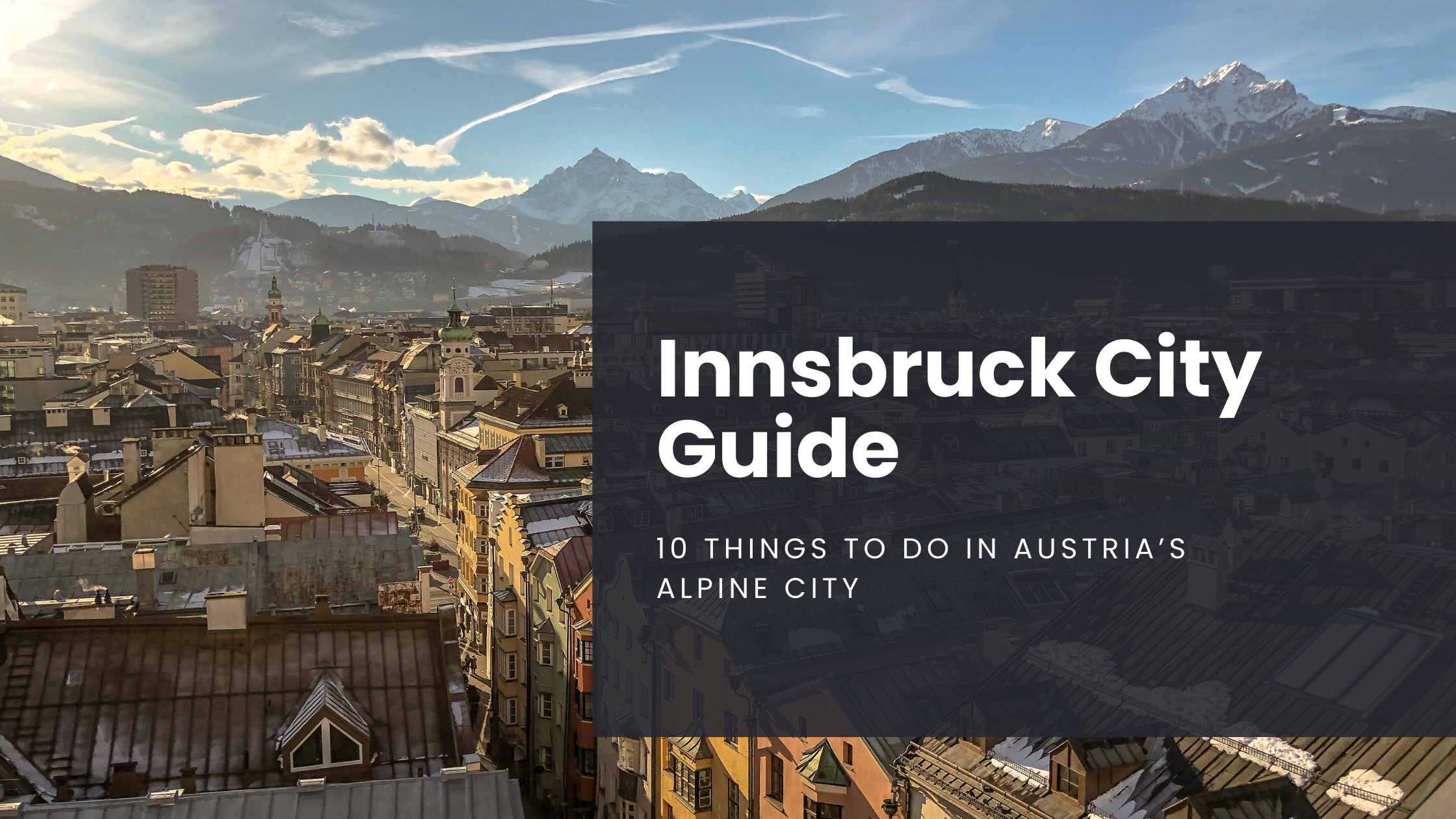
Innsbruck City Guide: 10 things to do in Austria's alpine city
From the local flavors of speck and strudel to the stunning mountainous views that surround the city, Innsbruck has something for everyone. It continues to sit at the top of the list of my favorite European cities and I can guarantee you’ll have a great time!
Please note: All information listed below is up to date as of May 2023
Tucked away within the shadows of the surrounding Alps lies Innsbruck, Austria.
A mountainous paradise that’s known for its rich Tirolean history and the epicenter of winter sports, having hosted the Olympics in both 1964 and 1976.
To this day, it remains one of my favorite European cities of all time and by the end of this post, you should have a pretty good idea as to why!
Let’s explore 10 of the top things to do when in Innsbruck, Austria.
1. SAVOR A STRUDEL AT CAFE KROLL
Nestled within Innsbruck’s old town, Cafe Kroll serves up some of the city’s best homemade strudel as voted by tourists and locals alike.
You can be sure to find a steady stream of customers from the moment the doors open in the morning straight until closing. It’s easy to be overwhelmed by the sheer volume of variety offered, but I would personally recommend giving the apricot and hazelnut strudel a try if in the mood for something sweet or the spinach and feta for savory.
Pro Tip: Cafe Kroll offers several gluten-free items, so there’s no excuse to stay away!
Hours: 6am - 9pm daily
Address: Hofgasse 6, 6020 Innsbruck, Austria
Website: www.strudel-cafe.at
2. EXPERIENCE THE JEWEL OF THE ALPS
Widely known as the “jewel of the Alps", the Nordkette mountain range sits just north of Innsbruck and rises to 8,651 feet at its highest point (Kleiner Solstein Peak) and is part of Austria’s largest Nature Park, the Karwendel.
Find your way to Innsbruck’s Hungerburgbahn Station and hop in the Hungerburg Funicular before catching a tram up to Seegrube (6,250ft.) and Hafelekar (7,401ft.) to enjoy the panoramic views of the city and surrounding mountains.
In the winter months, the area becomes a popular ski destination, the Hafekeler run being one of the steepest in all of Europe, and in the summer months, visitors can enjoy expansive hiking, climbing, and mountain biking.
It made for a great Christmas Day adventure during our most recent trip!
Pro tip: The Hungerburg Funicular will also take visitors to the Alpine Zoo, the highest in all of Europe. A combination ticket for the funicular and zoo entry will cost 19 euros per person.
Helpful Hints: The funicular from Hungerburgbahn Station is operational from 7:15am - 7:15pm M-F, 8am - 7:15pm Saturday and Sunday and runs every 15 minutes. The Seegrube cable car is open daily from 8:30am - 7:30pm while the Hafelekar tram operates from 9am - 5pm daily. Both run every 15 minutes.
Address: Hungerburgbahn Station, Rennweg 3, 6020 Innsbruck, Austria
Cost: Varies based one how many trams you choose to take, but expect to pay around 36.50 euros per person to get from the Hungerburgbahn Station to the top of the Hafelekar cable car (ski pass not included).
Website: More information on the entire area can be found by clicking here.

View from the top of the Hafeleker cable car
3. LOSE YOURSELF IN THE LAND OF SWAROVSKI CRYSTALS
Opening in 1995, the Swarovski Kristallwelten (crystal worlds) welcomes tourists to wander around 17 different underground “chambers of wonder,” each filled with stunning crystal art created by international artists.
When strolling through the gardens, be sure to not miss the Crystal Cloud, a piece comprised of 800,000 hand-mounted Swarovski crystals. Another fan favorite is the Crystal Dome, a room that contains 595 mirrors all working together to create stunning lighting and reflections.
At the very least, exploring the halls is a humble reminder to keep saving your money!
Pro Tip: Although the Kristallwelten is located outside of Innsbruck, a shuttle runs back and forth 5-6 times a day from various locations and costs 10 euros for a round trip ticket. More info can be found here.
Address: Kristallweltenstrasse, Wattens, Austria
Hours: 8:30am - 7:00pm, daily
Cost: 19 euros or free with an Innsbruck Card.
Website: www.kristallwelten.swarovski.com
4. STEP INTO THE RENNAISSANCE AT AMBRAS CASTLE
Once home to Archduke Ferdinand II, Ambras Castle is located in the southern part of Innsbruck and can easily be reached by tram and bus.
Ferdinand II was the prince known for elevating arts and sciences to new levels during his lifetime and the castle’s residential rooms have been transformed into the Habsburg portrait gallery (open to visitors between April and October).
Tickets cost just 12 euros and can be purchased ahead of time by visiting the castle’s website.
Address: Schlossstrassse 20, 6020 Innsbruck, Austria
Hours: Daily from 10:00am - 5:00pm, closed during the month of November
Website: Click here for more information or to purchase tickets.
5. CLIMB TO THE TOP OF INNSBRUCK CITY TOWER
I’ve visited Innsbruck more times than I can count, often passing through for a day or two, but I always make sure to leave time to climb the 148 stairs to the top of the Innsbruck City Tower.
It’s easily my favorite 360-degree view of the city, standing amongst the rooftops and watching life pulsate through the city streets below.
When the tower was still operational, it was manned by watchmen who were tasked with announcing the time every hour and warning the townspeople of incoming danger. The building also housed a prison during the Middle Ages on the ground floor.
Costing only 4 euros per person, this is one of the best “bang for your buck” things to do in Innsbruck and it doesn’t take much time at all! Important note: There is NO elevator available, so it may not be suitable for everyone.
Address: Herzog-Friedrich-Strasse 21, Innsbruck, Austria
Hours: Daily from 10:00am - 5:00pm (winter) and 10:00am - 8:00pm (summer)
Website: Click here for more information

View from the top of the Innsbruck City Tower
6. DEVOUR A PLATE OF SPECK AT TIROLER SPECKERIA
Since 1909 Tiroler Speckeria has been serving up some of the best Tyrolean bacon, commonly known as speck, found in all of Innsbruck.
Do yourself a favor and order the specialty board (15 euros per person). It’s a great way to experience the diversity of Tyrolean flavors and I assure you it will be worth every cent.
If you’re short on time, the owners also offer up sandwiches to take on the go, but I’d recommend taking the time to sit down for a short meal. It’s hard to beat the ambiance and delicious food.
Address: Hofgasse 3, 6020 Innsbruck, Austria
Hours: Daily from 9:00am - 6:00pm
Website: www.speckeria.at
7. CATCH A LOCAL SPORTING EVENT
There are two main sporting events to check out: Football Club Wacker Innsbruck and Hockey Club Tiroler Wasserkraft Innsbruck.
Formed in 2002, FC Wacker plays their home matches at Tivoli Stadium in downtown Innsbruck and currently competes in the Austrian Football Second League. The 16,000-seat stadium played host to the likes of Spain, Russia, Sweden, and Greece during the 2008 European Championships.
HC Tiroler Wasserkraft plays across the street from Tivoli Stadium at the Olympia World Innsbruck Complex. Along with soccer and alpine skiing, ice hockey is one of the most popular sports in all of Austria, so rest assured you’ll be in for quite the local experience without the normal influx of tourists.
Be sure to check the competition schedules during your trip!
Address: Stadionstrasse 1, 6020 Innsbruck, Austria
FC Wacker Innsbruck Website: https://fc-wacker-innsbruck.at/
HC Tiroler Wassercraft Innsbruck Website: https://www.hcinnsbruck.at/de-DE
8. REACH NEW HEIGHTS FROM THE TOP OF THE BERGISEL SKI JUMP
If you couldn’t tell already, I’m all about gaining new perspectives wherever I go in the world and the top of the Bergisel Ski Jump certainly offers a unique one!
Used in both the 1964 and 1976 Winter Olympics, the tower rises 47 meters towards the sky and features a restaurant at the top that rewards visitors with stunning 360-degree views of the surrounding mountains and city below.
The 28,000-seat stadium continues to hold the famed Four Hills Tournament each year, a staple of the winter sports world, so if you’re visiting in January then make sure to check a calendar ahead of time!
Address: Bergiselweg 3, 6020 Innsbruck, Austria
Hours: June to October from 9:00am - 6:00pm, November to May from 9:00am - 5:00pm
Entry Fee: 11 euros
Website: https://www.bergisel.info/at/
9. STROLL THROUGH INNSBRUCK’S OLD TOWN (ALTSTADT VON INNSBRUCK)
Take an afternoon to wander through Innsbruck’s 800-year-old city center and experience the charm and sophistication that exudes the mix of baroque and gothic architecture.
Walk along the Inn River to see the pastel-colored homes across the way, visit the Golden Roof and learn about the royal box where Emperor Maximillian I once watched over the city, or shop along the famed Maria-Theresien-Strasse.
Here is where you’ll stumble upon the Triumphal Arch which was commissioned in 1765 by Empress Maria Theresa to commemorate the marriage of her son to the Spanish Princess Maria Ludovica. Unfortunately, Maria Theresa’s husband passed away during the festivities, so the arch depicts a wedding on the southern facade and the mourning of her late husband on the northern. An interesting tale to say the least.

Golden Roof as seen from above
10. GO BACK IN TIME AT INNSBRUCK’S IMPERIAL PALACE
Constructed in the 1400s, the Imperial Palace is now split into several different museums including a furniture display, an ancestral gallery, and a painting gallery.
Next to the Vienna Hofburg and Schönbrunn, the Innsbruck Imperial Palace is amongst the three most significant cultural buildings in all of Austria!
Entry is free for children and only 9.90 euros for adults, making it a great value and the perfect rainy day activity.
If you’ve ever wondered what the inside of a palace looks like, this is the place to go!
Address: Kaiserliche Hofburg, Rennweg 1, 6020 Innsbruck, Austria
Hours: Daily from 9:00am - 5:00pm
Website: hofburg-innsbruck.at
So, there you have it: 10 of the top things to do when visiting Innsbruck, Austria! In a city that’s filled with so much history, culture, and beautiful mountains, it’s hard to go wrong with whatever you end up deciding to do. I hope you enjoy your trip!
Have you been to Innsbruck before? Did I leave something out? Let me know about your experiences in the comments below and, in the meantime, stay safe & happy travels!
Looking for a tour? Check out these great options!
Was this post helpful? Pin it for later!


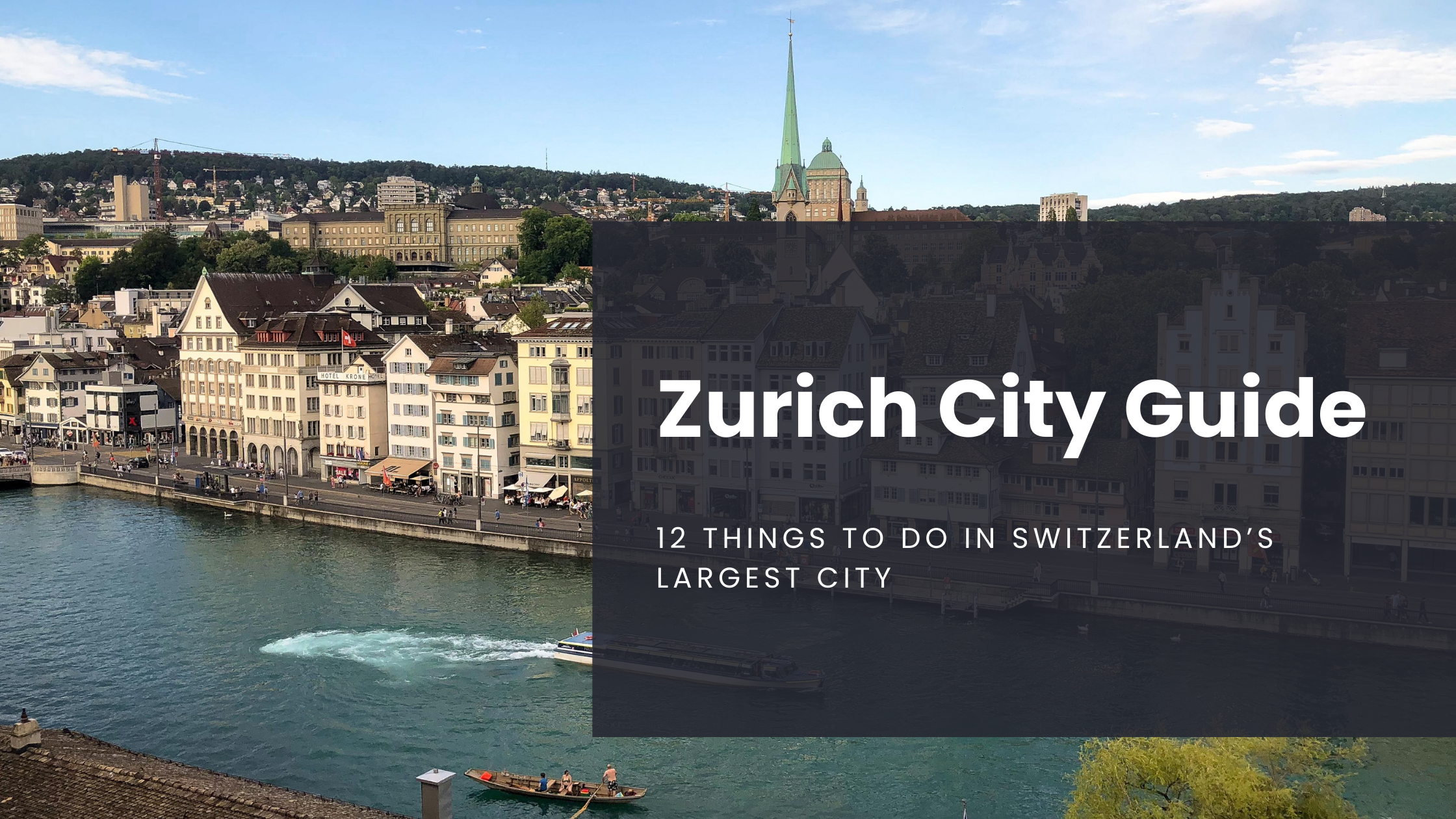
Zurich City Guide: 12 things to do in Switzerland's largest city
Whether it's 5 hours or 5 days, here are some different ways to make the most out of your time in Zurich, Switzerland. Be sure to pack an appetite!
Please note: All information below is up to date as of May 2023
Work has kept me on the move for the better part of the past four years, bouncing between towns and villages around the world every few days. My restless feet have never been known to balk at the chance to explore a new place, so I’ve grown accustomed to taking myself on whirlwind tours of wherever I might find myself.
Thankfully, a Switzerland itinerary Switzerland itinerary has frequently appeared on the calendar.
Zurich is a place I’ve been to on a few different occasions, each lasting less than 24 hours. It’s a city full of history, beautiful architecture, and delicious cuisine, so it’s easy to find something for everyone.
Here are the 12 top things to do when visiting Switzerland’s largest city. Spoiler alert: bring your appetite.
1. LINDENHOF PARK
Located within Zurich’s Altstadt (old town), Lindenhof Park offers panoramic views over the River Limmat and sits on top of the city’s remaining Roman medieval wall. The square also happens to be the site of the Roman and Carolingian era kaiserpfalz, the emperor’s castle, in which the city was built around.
Grab a beer and a pretzel, take a seat on the wall, and enjoy the views in the evening glow. It’s a popular thing to do in Zurich for both locals and tourists alike!

Lindenhof Park - Zurich, Switzerland
2. FIFA WORLD CUP MUSEUM
What better place to learn about Europe’s most popular sport than where the headquarters of the Federation Internationale de Football Association, otherwise known as FIFA, is located?
Opened in 2016, the FIFA World Football Museum takes visitors on a journey through the sport’s history with over 1,000 exhibits, photographs, and texts. It certainly doesn’t hurt that entry is free when you use your Zurich Museum Card.
If you don’t have one, it’s no problem! A ticket will cost you CHF 24 (just over $24) and can be purchased online by clicking here. It makes for a great rainy-day activity!
Address: Seestrasse 27, 8002 Zurich, Switzerland
Hours: 10am-6pm. Closed on Mondays, so plan ahead!
Website: www.fifamuseum.com
3. RESTAURANT LE DEZALEY
Add a hearty portion of Emmenthaler cheese to a moderately aged Gruyère, melt it down, put together a plate of charcuterie, and what do you get? One heck of a meal!
Tucked away in Zurich’s old town, Le Dezaley has been serving up some of the best Swiss dishes in all of the city since opening its doors in 1903, but there’s one main reason to visit: the fondue.
Despite feeling as though you’ve uncovered a hidden gem, the consensus is that the chefs at Le Dezaley do fondue better than anyone else around, so your safest bet to ensure access is to reserve a table ahead of time which, conveniently enough, can be done online by clicking here.
Wherever you choose to go, devouring cheese fondue is a must-do during your time in Zurich! Bonus points if you can say “Swiss dish” ten times fast.
Address: Romergasse 7-9, 8001 Zurich
Hours: 11:30am - 2:00pm & 6:00pm - 12:00am, closed on Sundays
Website: www.le-dezaley.ch
4. OLD TOWN
Also known as Altstadt, this quaint and car-free part of Zurich is where history began for Switzerland’s largest city. It’s here where you’ll find some of the most important landmarks, such as the Fraumunster Church which was built in 853 by the German King Louis for his daughter, Hildegard.
The church is now home to a set of five stained glass windows from world-renowned artist Marc Chagall and serves as a popular destination for tourists.
If shopping is more your thing, make your way over to the Niederdorf District and browse the selection of eclectic boutiques.
Wandering isn’t for everyone, and that’s ok. Luckily there are free tours of the city that lead visitors around to all of the major cultural spots and are available in multiple languages. Visit Free Walk Zurich’s website for more information.
5. RIVER LIMMAT CRUISE
All you need is an hour to spare to discover Zurich from the water.
Embarking from the National Museum, the River Limmat Cruise offers a cheap way to float past famous landmarks around the city, such as the Grossmunster Church and Town Hall, as you make your way to Lake Zurich. The glass-roofed boats guarantee an incredible view regardless of your seat.
Be sure to check dates and timetables in advance as tours are only offered between April and October. The best part? prices start at CHF 6.80 (USD 7.50)!
Address: Zurich Landesmuseum Schiffsteg, 8001 Zurich, Switzerland
Timetables: Click here.
Special Note: The company’s website specifically mentions that boats are not suitable for wheelchairs.

Zurich, Switzerland as seen from the River Limmat
6. LINDT CHOCOLATE FACTORY
This is your chance to live like Willy Wonka.
The Lindt factory offers a glimpse into how different chocolates are made as well as a variety of classes so that you can learn to make your delectable dessert under the tutelage of a master chocolatier.
A new 20,000 square meter facility, The Lindt Chocolate World, will open in 2020 and serve as the chocolate lover’s version of Disney Land, containing the world’s largest Lindt store and chocolate fountain in addition to interactive exhibits and a research facility amongst other things.
Surely this will quickly rise to the top of things to do in Zurich once it opens. I’m drooling already!
Address: Seestrasse 204 , 8802 Kilchberg
Website: www.lindt.ch/en/
7. UNIVERSITY OF ZURICH BOTANICAL GARDENS
Travel around the globe without ever stepping foot outside of Zurich!
From alpine flowers to Mediterranean plants, there’s plenty to see, smell, and explore at the University of Zurich’s Botanical Gardens.
In total, the facility houses 9,000 plant species as well as 3 tropical domes. Entry is free and the greenhouses make for a great way to get your nature fix during a cloudy day! Visit during spring for the best viewing.
Address: Zolilkerstrasse 107, 8008 Zurich
Hours: 7am - 7pm during the week in the summer (8am-6pm on weekends), hours may vary during the off-season
** Tropical greenhouses are open from 9:30am - 5:00pm during summer months, hours may vary during the off-season
Website: Zurich Botanical Gardens
8. KARLSTURM TOWER
For sweeping views across the rooftops of Zurich, head over to the Karlsturm Tower and pay CHF 5 (or free for Zurich Card holders) to climb the 187 stairs to the top.
Part of the Grossmunster Church, this famous landmark is a former monastery that was built on top of the graves of the city’s patron saints, Felix and Regula.
With its rich history and panoramic views, this is a must-do activity in Zurich!
Address: Grossmunster, Grossmunster Platz, 8001 Zurich
Hours: Opens 10am, Monday-Saturday and 12:30pm on Sundays
Website: www.grossmuenster.ch
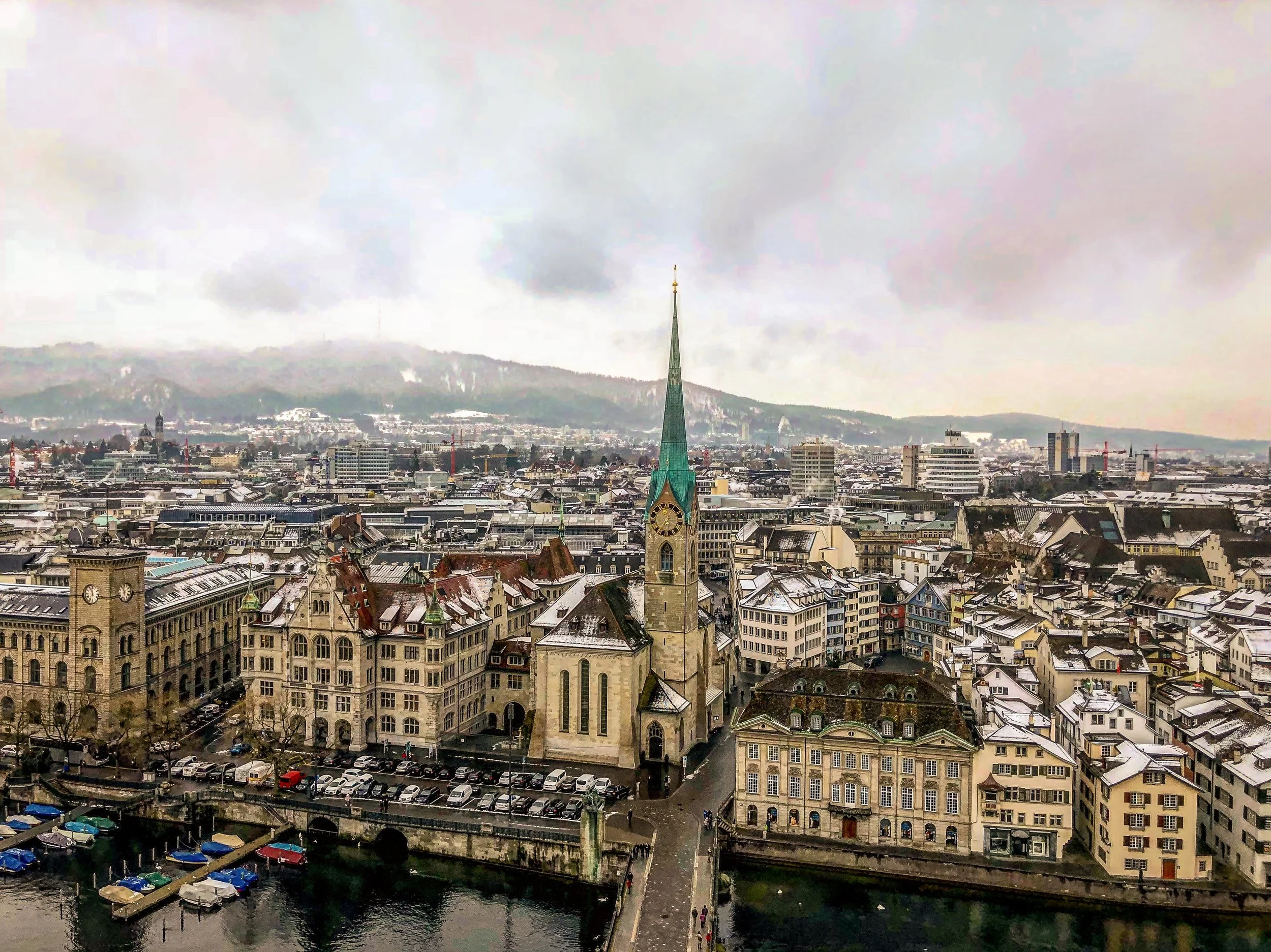
Zurich from above
9. LAKE ZURICH
The most expansive scenery around Lake Zurich can be found at the Burkliterasse, located at the end of the Bahnhofstrasse shopping street.
On a clear day, you’ll be able to see as far as the Swiss Alps!
Itching to get out on the water? This is where the Lake Zurich Navigation Company offers daily cruises that range from 1.5-4 hours in length. Spice things up and book a trip aboard the cheese fondue boat or break out the spandex and hop on the 80s party cruise!
Address: Burkliplatz, 8001 Zurich, Switzerland
Cruise Cost: Varies based on chosen package
Website: Lake Zurich Navigation Company
10. STERNEN GRILL BRATS
Locals and foreigners agree: Sternen Grill is home to Zurich’s best sausage.
Some say it’s the soft bread roll that puts it over the top while others are infatuated with the delicious spicy mustard. Either way, it’s worth the visit.
Seating is available, but my recommendation is to grab a takeaway, cross the street to the Sechselautenplatz and savor your brat while sitting lakeside beneath the shadows of the Opernhaus Zurich.
Roasted chicken is also available for purchase, so don’t worry if brats aren’t your thing.
Address: Theaterstrasse 22, 8001 Zurich, Switzerland
Hours: 10:30am - 11:45pm, daily
11. SWISS NATIONAL MUSEUM
Located along the River Limmat and mere minutes from the train station, this museum is the most frequently visited in all of Switzerland.
Exhibitions usher visitors chronologically through ancient times, Middle Ages, and into the 20th century. Entry is free with the Zurich Museum Card or CHF 10 without it.
This is also where the River Limmat cruise boats depart, so not only is it a great way to learn about Switzerland’s history but then you can get out and explore it!
Address: Museumstrasse 2, 8001 Zurich, Switzerland
Hours: 10:00am - 5:00pm, closed on Mondays
Website: www.landesmuseum.ch/en
12. CHINAGARTEN
An underrated yet great thing to visit in Zurich is the city’s Chinese Gardens, especially if you’re in search of peace and tranquility.
The garden was a gift from Zurich’s sister city, Kunming, as a way to express gratitude for the Swiss’ efforts in providing technical and scientific support towards the expansion of drinking water supplies and urban drainage.
Certainly a beautiful place with a meaningful story behind it.
Address: Bellerivestrasse 138, 8008 Zurich
Entry Fee: CHF 4
Hours: 11:00am - 7:00pm
** The garden is closed in winter months
Website: Zurich Chinagarten
Whether you have 2 hours or 2 days to wander the city, it’s worth getting out and about to experience the Swiss culture.
Snack on a pretzel, sample some chocolate, and learn about the history as you go!
Have any other recommendations for Zurich that I might have missed? Feel free to leave a comment below. I enjoy hearing from you all!
Thanks for following along with Toone’s Travels! As always, stay safe & happy travels.
Check out these tours through GetYourGuide:
Sharing is caring… pin this post for later!


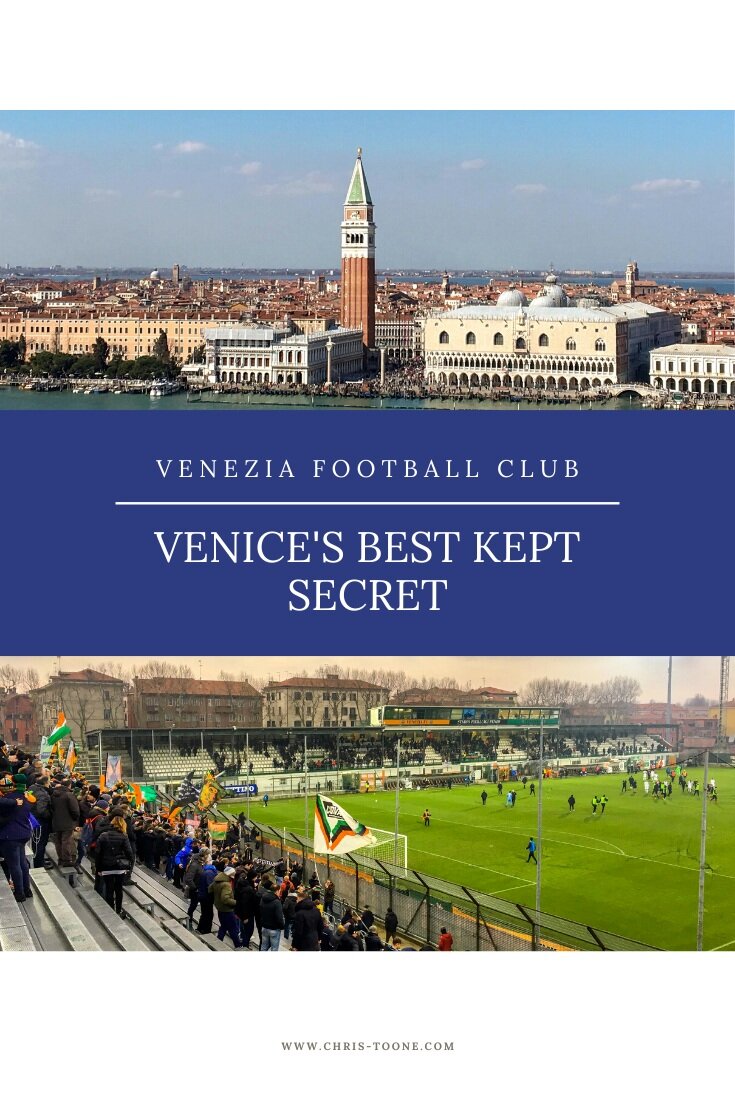
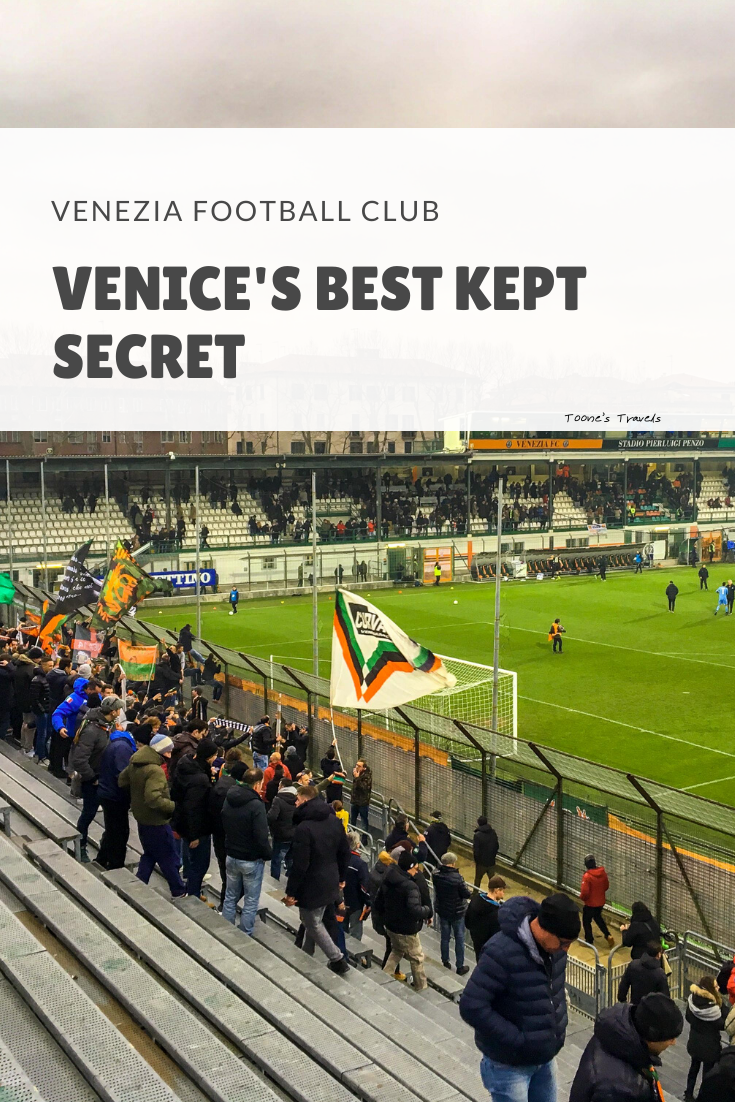
Venezia Football Club: Venice's best kept secret
In a city that welcomes 30 million visitors each year, it seems unlikely that something has been left undiscovered, right? Think again. Venezia Football Club has remained raw, authentic, and full of passion despite the modern age of overtourism. Sport fanatic or not, it’s worth checking out. Here’s why…
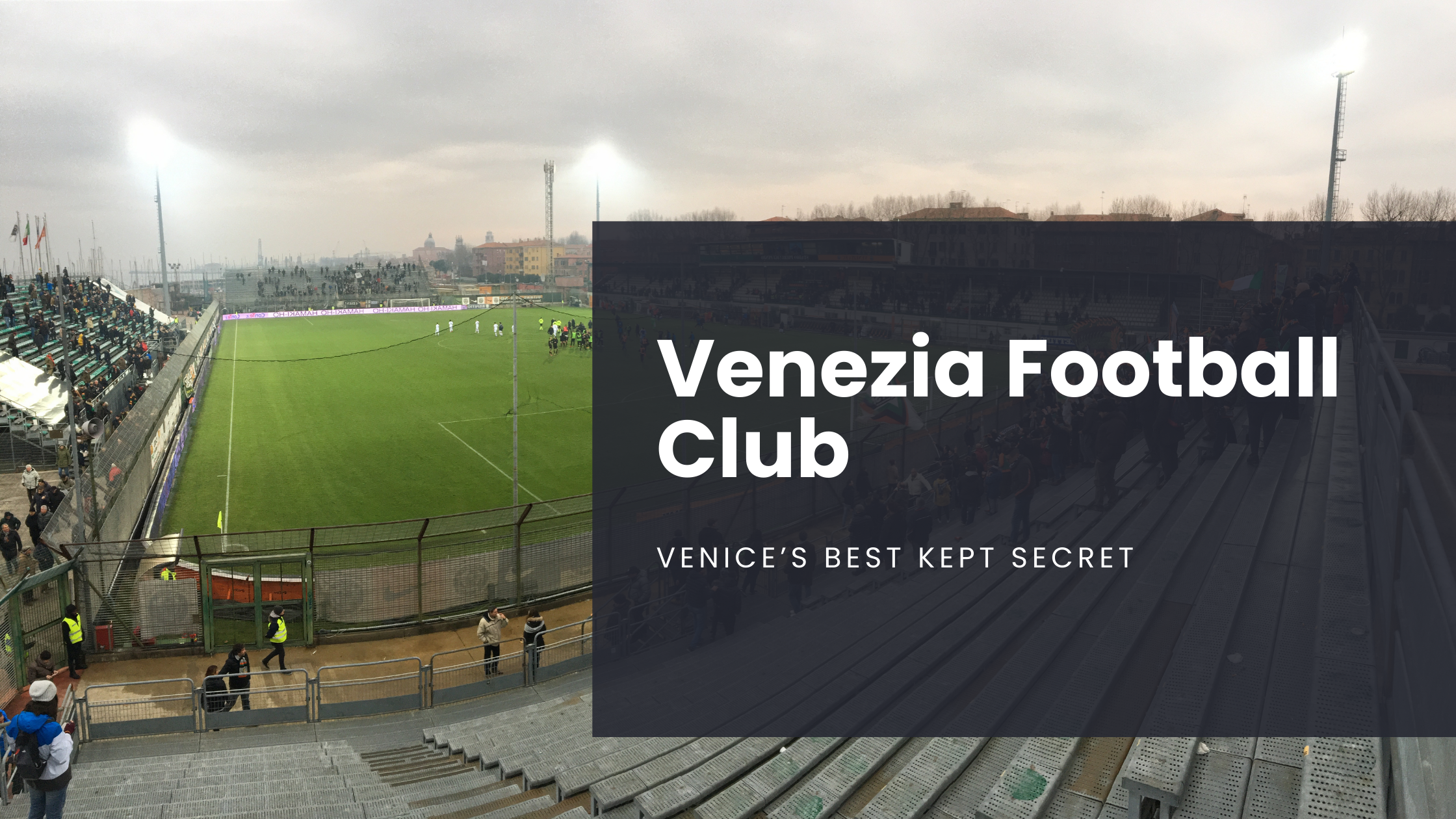
Before reading: Venezia FC was promoted to Serie A in 2021 for the first time in 19 years but was forced to cope with relegation and is currently back competing in Serie B.
Travel writer Thomas Watkins once wrote, “There is no country so much frequented yet so little known by foreigners as Venice [Italy].” That was back in 1788, but hundreds of years later it’s still true.
The reality is that 30 million people tour the Venetian Lagoon each year, eager to capture the perfect selfie in St. Mark’s Square. They pay hundreds of dollars for gondola rides, put out for overpriced cocktails in the famed piazzas, and live their fantasy of calling this lustful place home, even if only for an afternoon.
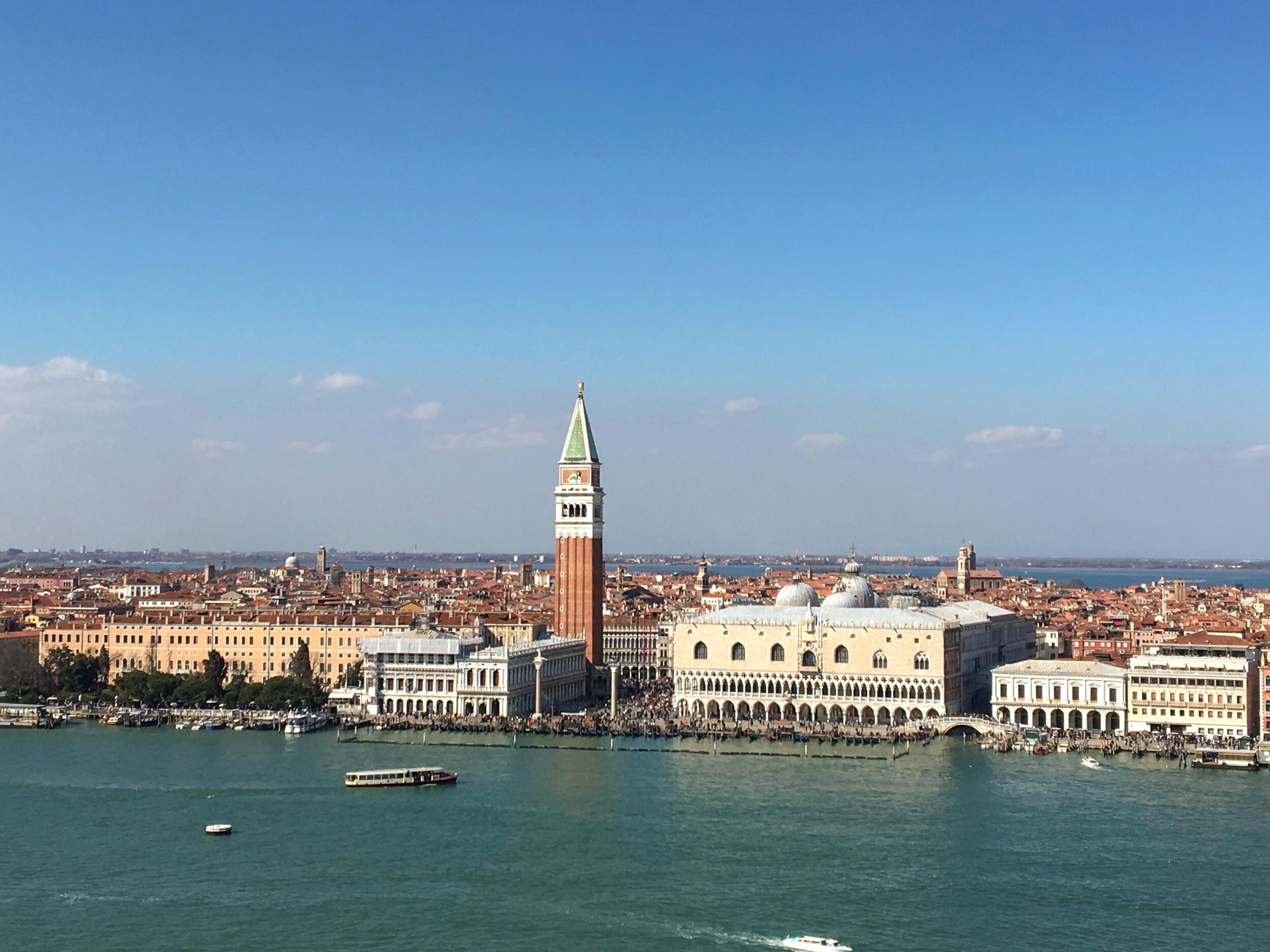
St. Mark’s Square as seen from the San Giorgio Bell Tower
It’s not easy to look beyond the facades of the San Marco district and why would anyone need to? There is natural beauty and history at every turn. Despite this, I couldn’t help but feel there was more to Venice than meets the eye.
Cue the Venezia Football Club. A professional soccer team formed in 1907 that competes in Italy’s second division (Serie B) and, despite the high volume of foot traffic within the city’s limits, is still undoubtedly hidden within the easternmost confines of the city. It has a history. It has a culture. It has passion. Yet rarely do foreigners ever experience it.
The club plays its home matches at the Stadio Pierluigi Penzo, a cozy 11,150-seat stadium that’s tucked away deep within the Sant’Elena district. A quick search of the web will explain how it’s the second oldest continually used venue in all of Italy. That’s quite an impressive feat when you consider the deep history of Italian football but somehow remains largely invisible to a majority of the city’s visitors.
It’s certainly not the easiest place to find. There are no banners, no yellow signs indicating a point of interest like those seen plastered around the tourist trail, and no walking tour in sight. The stadium is simply there, hidden in plain sight for better or for worse and serving as a discrete monument of stability within a city that’s constantly changing.

Inside Stadio Pierluigi Penzo - Venice, Italy
During my first visit, I didn’t learn of the club’s existence until the day after they had played at home. I wasn’t about to make that same mistake the next time I found myself aimlessly wandering the canals of Venice and sure enough, the stars aligned a year later.
On the day of the match, indescribable energy filled the air. Fans from Mestre, Venice’s mainland neighbor, packed the water taxi like a can of sardines, disembarking at the Sant’Elena pier before making their way to the stadium. It wasn’t a long walk from the docks by any means, but I’ll always remember the roar of the crowd directing the newcomers, guiding us through the streets, and growing louder with each step.
Once inside, I couldn’t help but feel as though I was witnessing a religious experience of sorts. Sure, Venice is full of cathedrals, but the Stadio Pierluigi Penzo is one that never receives attention. It’s a different kind of church, of course. A holy place where Venetians gather, rain or shine, to pay tribute to what many refer to as the most beautiful game in the world.
I took my seat in the Curva Sud section, home to the club’s diehard supporters. Organized chaos is the only way to describe it as a couple of delirious individuals led continuous chants throughout the entire 90 minutes, never once taking their eyes off the crowd. This was the heartbeat of everything, setting the tone for fans and players alike.
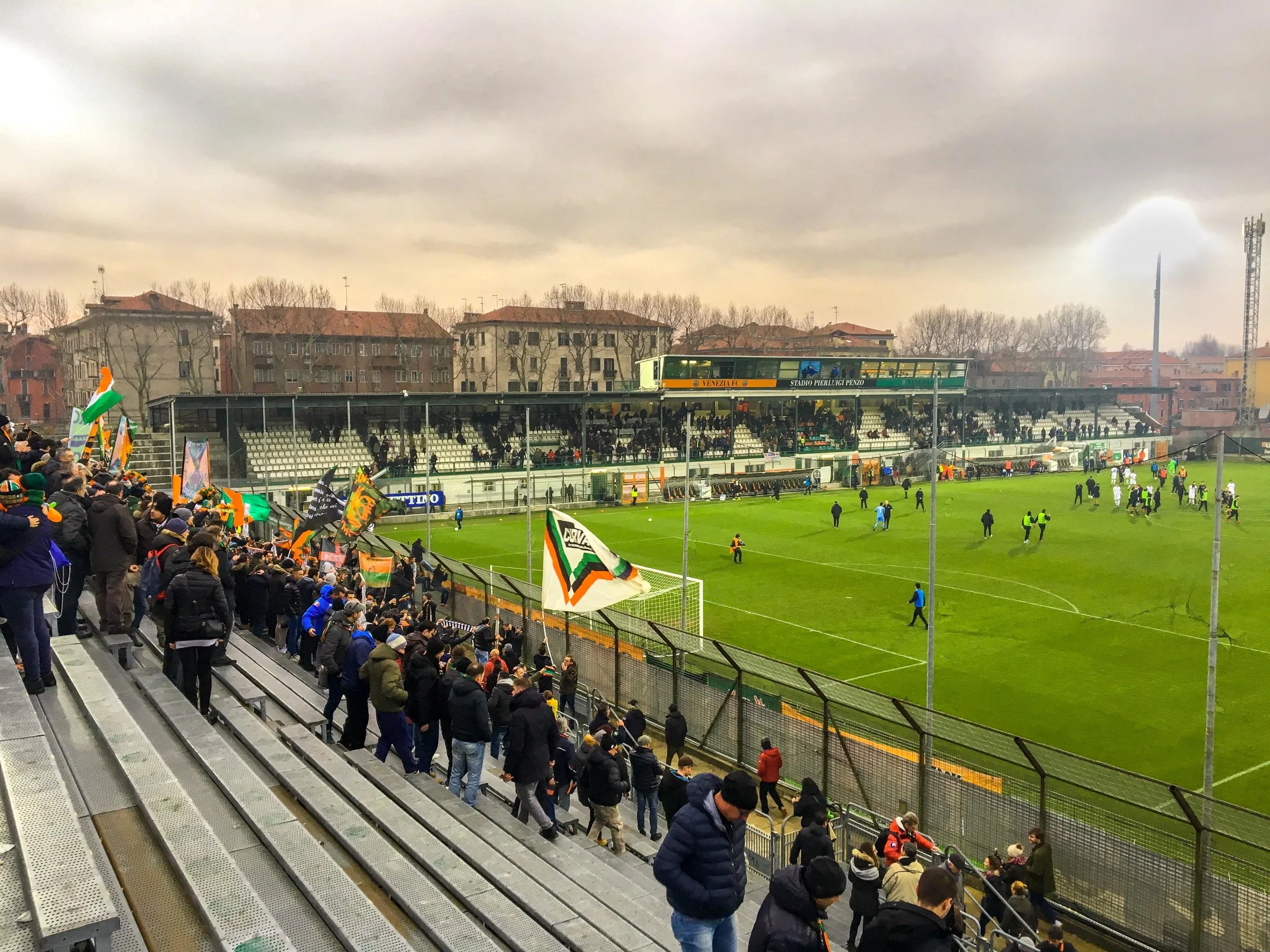
On the northern end of the stadium stood the away supporters, valiantly trying to make their presence felt with flags and cheers of their own, all the while seemingly un-phased by the uphill battle they faced. It was to no avail on this particular afternoon.
The atmosphere was a far cry from the luxury and sophistication that exude the shops along the Grand Canal. There was nothing “high end” about it, nor should there have been. Instead, the beauty of this moment came from within the people, their raw emotion filling the stadium like a pressure cooker that could only be released when the ball struck the back of the net in favor of the home side.
Anyone who knows me is well aware that I consider myself to be completely infatuated with the sport of soccer.
It’s only natural that I would come away loving the experience, but trust me when I say that this was different. On a gray, dreary, and otherwise lifeless February afternoon, the Sant’Elena district was alive and well thanks to an overlooked staple of Venetian life: The Venezia Football Club.
Wander amongst the canals of Venice and it’s easy to feel the rich history oozing from the walls of the city but step inside the Stadio Pierluigi Penzo on match day and you suddenly become part of it, living amongst the pages as they’re written.
This was the first time that I felt as though I had been gifted a small glimpse into the real life of Venice and for that, I will forever be a fan of Venezia F.C. Grazie, thank you, Winged Lions!
Thanks for reading and as always, stay safe & happy travels!
Enjoy this post? Make sure to pin it for later!

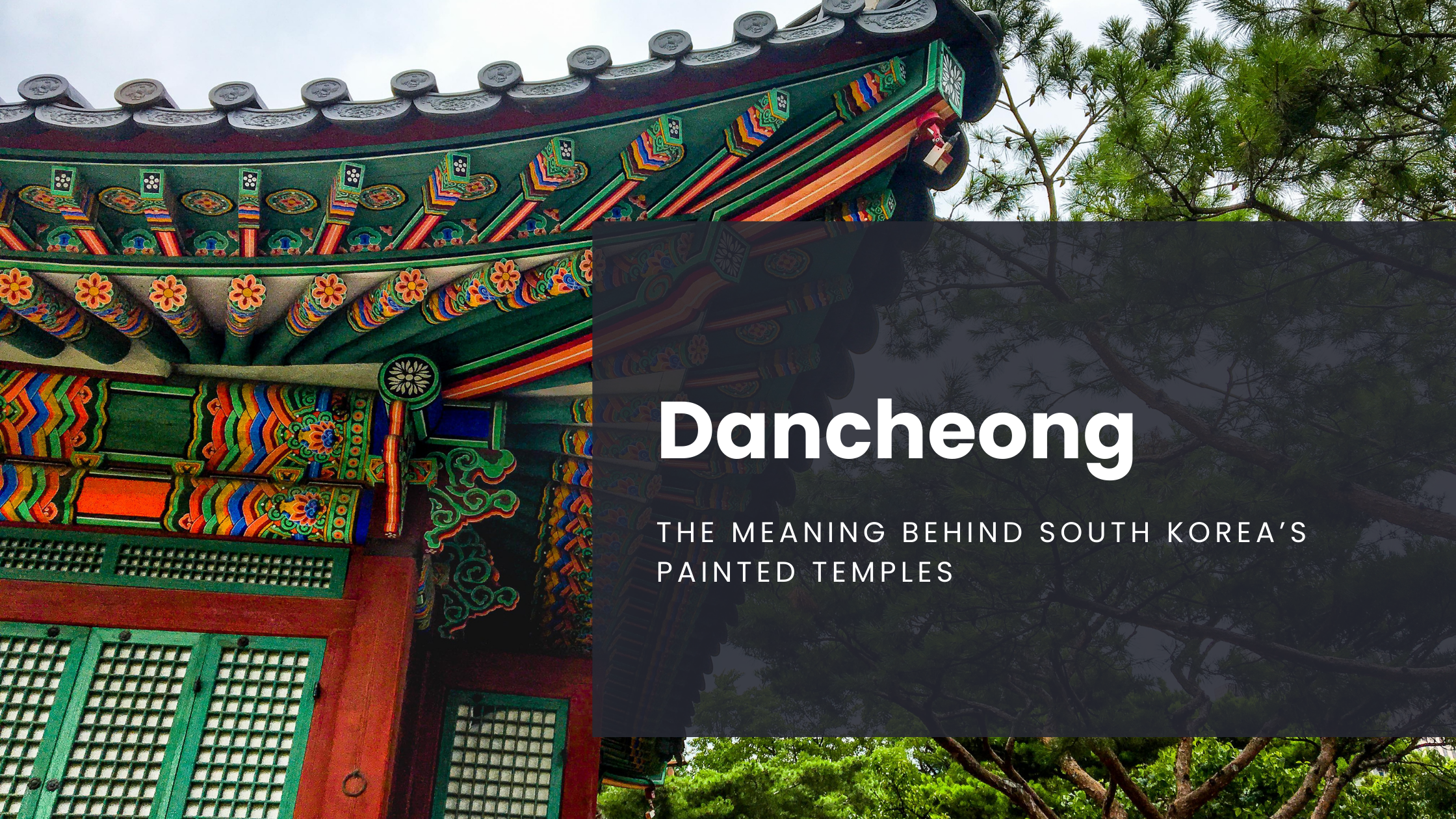
Dancheong: The meaning behind South Korea's beautifully painted temples
Ever wonder why South Korea's temples are all the same colors, regardless of design and location? The answer lies within a single word: Dancheong. Here's the story of what it all means.
Ah, South Korea.
A land that seeks to balance urbanization with rich cultural traditions. A place where one can simultaneously feel overstimulated and completely at peace.
At times it felt as though I was embedded into one giant oxymoron, or maybe it’s just the one place in the world that had it “all figured out.”
Both are extreme exaggerations, but the country completely captivated me during my time there (the seemingly endless supply of dumplings and kimchee sure didn’t hurt, either).
In general, I tend to notice the subtle things when I’m in a new place and South Korea was no different. It’s these microscopic findings that keep me up at night, trying to critically think my way toward a novice interpretation of my surroundings.
As I wandered around the palaces of Seoul, I couldn’t quite pinpoint why all of the buildings were decorated with the same vibrant hues of red, blue, and green, but it gnawed away at my mind to the point of feeling compelled to write this post and share it all with you.
Yes, ok, it’s only natural to assume that there is some religious meaning tied to Buddhism, and, generically, that’s not wrong, but I’m talking more specifics.
Why are the brush strokes the way they are? Why are the colors so limited? Why so bright?
The answer lies in one word: Dancheong
THE HISTORY
Dancheong is the symbolism behind all of South Korea’s beautifully painted temples, referring to the uniform five-colored designs. The word can be translated directly as “red and green” and dates back to prehistoric times when the concept was found to be adorning the walls of tombs from the Three Kingdoms of Korea era (57 BC - 668 AD).
As time went on, dancheong spread from places of eternal rest to buildings of prominence. Not only did the vibrant design convey the importance and status of the residents, but it also served as a meaningful way to preserve and protect the wooden structure from the weather.
To this day, dancheong is limited to temples and palaces and in some cases, musical instruments.
Looking for more reading about South Korea?
THE COLORS AND SYMBOLS
All dancheong designs use the same five colors, each relating to the 5 elements theory in their own way:
blue: east, dragon, spring, and wood
red: south, birds, summer, and fire
white: west, tiger, fall, gold
black: north, hyeonmu (an imaginary animal that is part turtle and part snake), winter, and water
yellow: center, periods of time between seasons, and Earth
Together, it is believed that these colors epitomize the Korean desire for stability and peace in the present life, while working towards a rewarding afterlife.
Creating the masterpiece is just as much a work of art as the finished product itself.
Artisans must operate in unison to devise these complex and intricate designs, all while utilizing various symbols and patterns.
As one might imagine, highly specialized painters are required and each artist working on the project is responsible for one single color throughout the entire process.
Common symbols found throughout a dancheong design include:
3 circles: typically outside of large buildings and located up towards the roof, these represent heaven, earth, and the moon
Fish symbol: when located on the main Buddha table, this represents the effort and determination necessary for attaining eternal enlightenment
Swastika: Ancient buddhist symbol of peace, harmony, and good luck
Lotuses: Represents ignorance when rising from mud and enlightenment when ascending towards a clear sky

Location can also determine the color used. For example, exterior walls and pillars of buildings that receive sunlight are traditionally painted red
THE TYPES
The art of dancheong can be dissected into four main types, often identified based on location or patterns used.
Morucho: This is a pattern used on both ends of supporting beams, incorporating simple symbols such as a water lily, pomegranate, bubble, feather, or a green flower
Byeoljihwa: Traditional storytelling that is present between two morucho and consists of holy animals (such as dragons, lions, horses, or cranes) along with sagunja (specual plants such as plums, orchids, or bamboo) and scenes of the buddha sutra
Bidan munui: This pattern is full of diverse colors used to create geometric shapes
Dangdong munui: Used to describe when a single flower, animal, gemoetric shape, or pattern appears in one section
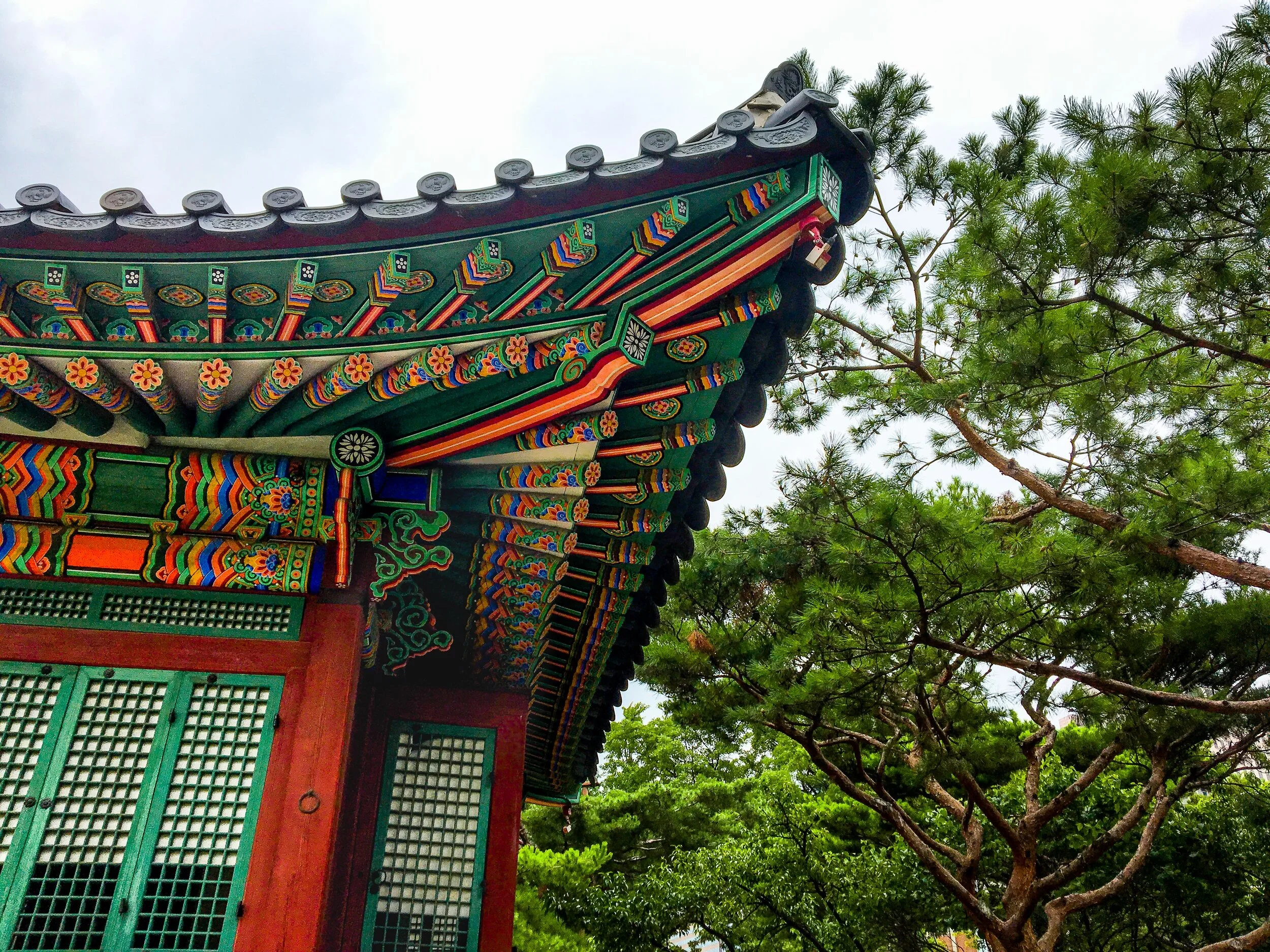
An example of morucho dancheong - a single flower is painted on the end of each beam
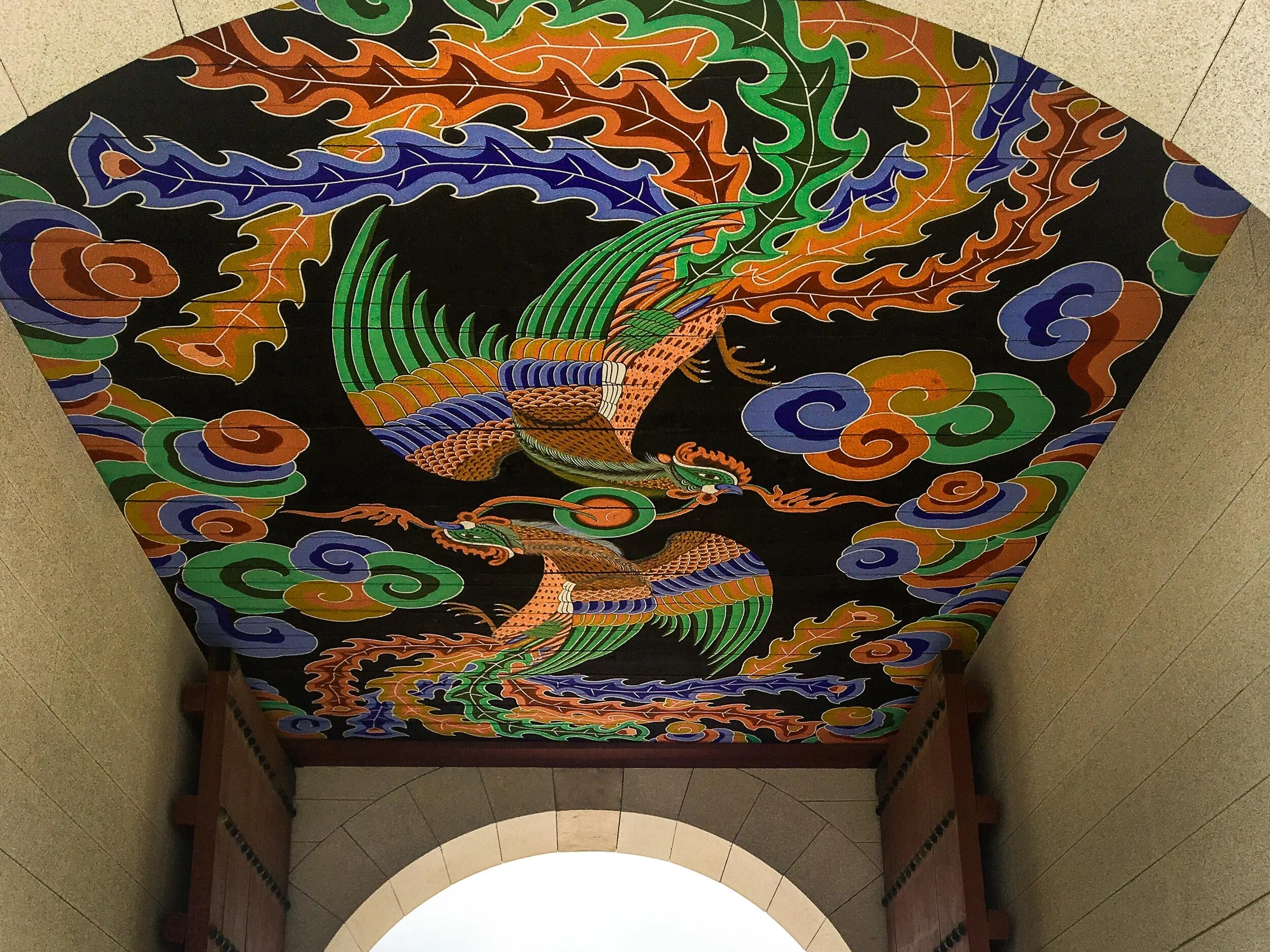
An example of byeoljihwa dancheong
So, there you have it. A brief story behind South Korea’s majestic and eye-catching temples, yet a much deeper understanding of ancient Korean values and beliefs. Next time you find yourself in new surroundings, or even in a place that you visit often but don’t know much about, be sure to take a step back and simply wonder. You never know what new meaning you might discover!
Thanks for stopping by and as always, stay safe & happy travels!
Sharing is caring… pin this post!


5 Common Misconceptions About South Korea: Here's what I learned during my first visit
Take a moment to think about South Korea. What comes to mind? Odds are it includes something along the lines of North Korea, kimchee, Buddhism, and not much more. That’s ok! Here are 5 common misconceptions about this stunningly beautiful and wildly underrated country, because their neighbors to the north shouldn’t be a reason to stay away.
Take a moment to think about South Korea. What comes to mind? Something along the lines of North Korea, kimchee, and Buddhism. I knew next-to-nothing about the country before I spontaneously booked plane tickets two weeks in advance — I'm not very planning-oriented when it comes to travel (learn from my mistakes and do a bit of preparation ahead time before visiting South Korea)!
Once word had spread about my upcoming adventure, it was only natural that my inbox was filled to the brim with a slew of questions:
Is it safe? What if North Korea attacks?
What if you don’t like the food?
How will you communicate? What happens if you need help?
To be honest, I couldn’t answer any of those questions at the time. I would simply stumble my way through a response to not only calm the nerves of those asking but my own as well.
It wasn’t until I arrived in South Korea and experienced all that it has to offer that I realized there was nothing to fear. So, here are 5 common misconceptions about this strikingly beautiful, amazingly peaceful, and wildly underrated country. Enjoy!
MISCONCEPTION #1: IT’S NOT SAFE
It’s only natural that when one thinks of South Korea, North Korea comes to mind. Technically speaking, the two countries are still at war (an armistice agreement was signed in 1953 that effectively ended all combat). There must be a plethora of safety concerns that come from this, right? Wrong.
Unless traveling to the demilitarized zone, there is seemingly no tension, emotional or physical, among South Koreans. Instead, the 10 million people living 50km away from the border in Seoul go about their daily life uninterrupted. It was easy to forget where I was in the world until I checked a map.
At the end of the day, South Korea is a very safe country to visit; don’t let its location in the world keep you away!
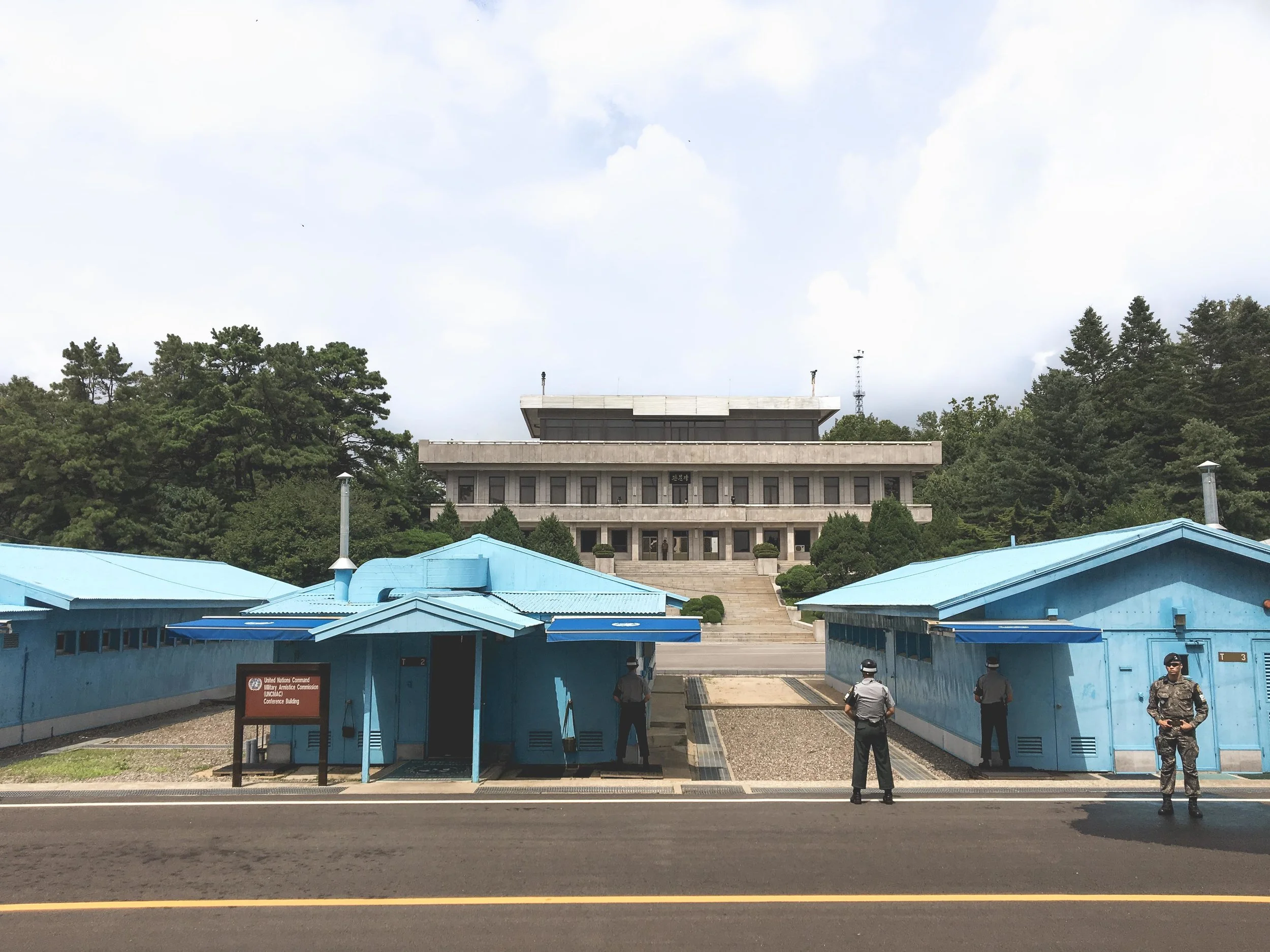
Demilitarized Zone at Joint Security Area - South Korea
MISCONCEPTION #2: IF YOU DON’T ENJOY BUSY CITIES THEN SOUTH KOREA ISN’T FOR YOU
Did you know that South Korea has the fastest internet in the world? Or that nearly 51.5 million people co-exist within a country similar in size to Tennessee?
There are numerous facts that may lead one to believe that South Korea is a type of futuristic, technologically-advanced, population-dense country, especially when cities such as Seoul and Busan are often at the forefront of itineraries. What many don’t realize until they arrive is that over half of South Korea is covered in forests and mountains.
The best part? You don’t have to travel far to reach them!
Bukhansan National Park is located a mere 13km from Seoul, making it easy to trade in the city streets for a mountainside temple. If flora and fauna peak your interest over rocky cliffs, then be sure to wander around Dadohaehaesang, South Korea’s largest national park. Here you’ll spot over 1,500 species of plants and 140 different kinds of birds.
Mountains don’t do it for you? That’s fine. South Korea is also home to 2,313 km of coastline, including Jeju, the country’s own island paradise.
With so much to offer, there’s an adventure for everyone!
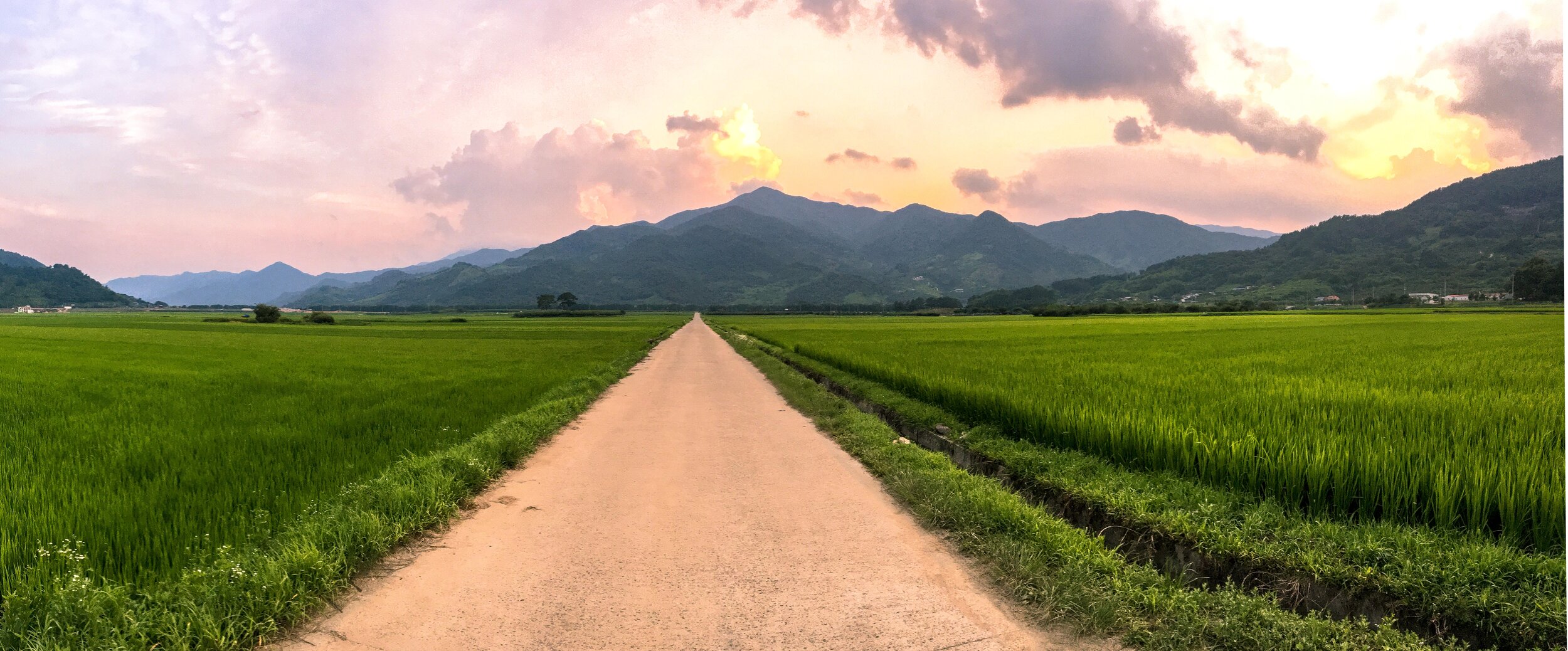
Hadong, South Korea
MISCONCEPTION #3: ALL SOUTH KOREANS SPEAK ENGLISH
Although English lessons are part of the modern-day South Korean education system, it’s important to realize that the language isn't always widely spoken.
As a result, English comprehension is generally, not always, limited to people under the age of 40. Older generations may know a few keywords and phrases but often aren’t comfortable conversing with someone fluent. There’s no harm in that, but what do you do when you’re lost and in need of help? Find a younger adult.
Seeking a more meaningful interaction and fewer charades?
Take a stab at learning Korean! Rather than relying on a plethora of confusing symbols, the language is based on a 24 character alphabet known as Hangul and is widely considered to be easier to learn than other languages such as Japanese and mandarin. The language wasn’t organically grown over time. Instead, the Hangul alphabet was specifically invented to be easy to use, in large part due to its phonetically-friendly nature.
Think of it as your passport into Korean society without much effort.
For more reading on South Korea, check out these posts:
MISCONCEPTION #4: BUDHISM REIGNS SUPREME
Buddhism may be one of the oldest religions in South Korea (established in 372), but the country has developed into a holy melting pot as centuries have passed. Yes, Buddhist beliefs remain a pillar of South Korea’s cultural heritage, as does Confucianism, but it’s only the second most practiced religion. A 2015 census showed that 19.7% of South Koreans identified as Protestants (thanks to North American missionaries dating back to the 19th century), which was more than both Buddhism (15.5%) and Catholicism (7.9%). Islam also continues to grow since the inception of the Islamic Society of Korea in 1955.
It’s hard to ignore the tens of thousands of temples constructed throughout the country but peel away the surface and you’ll find yourself staring deeper into a religious spectrum that many never realize exists, let alone experience.

Daewonsa Temple - South Korea
MISCONCEPTION #5: IT’S IMPOSSIBLE TO FIND NON-TRADITIONAL FOOD
South Koreans love their kimchee. Whether it’s served as a traditional side dish (known as banchan), stuffed inside of a dumpling, or simply a meal of its own, this spicy fermented cabbage is widely available for consumption at every turn. The same can be said of other traditional Korean dishes such as bibimbap (mixed vegetables and rice), tteokbokki (spicy Korean rice cakes), and makgeoli (a milky, off-white fermented rice drink).
Although the traditional culture and food are well preserved and respected throughout the country, the younger generation has grown up with more options that seemingly expand each day. South Korea ranks fourth in the world for the most Starbucks stores per capita (with 1,008 stores total, that’s one outlet for every 50,000 people) and it’s not uncommon to stumble upon the golden arches of McDonald’s as you meander through city streets. Despite what some may lead you to believe, it’s relatively easy to satisfy even the most western of taste buds.
It doesn’t have to be all big-business, though. How do fried chicken and beer sound?
Together, the two are known as “chimaek” and the obsession runs deep. So deep in fact that Daegu hosts an annual festival dedicated solely to this delectable combo — all the more reason to visit in July! You can read more about how this craze came to be by clicking here.

Gwangjang Market - Seoul, South Korea
So, what do you think? I hope that, in the very least, a trip to South Korea sounds more enticing than it might have prior to reading this post. Give it a go. After all, how do you know if you enjoy something if you don’t try it?
Thanks for reading and as always, stay safe & happy travels!
Pin this post and share with others!