

Virtual Trip Around the World: Because the travel bug waits for no one!
It's no secret that the travel bug waits for no one. Follow along on my Semester at Sea itinerary from 2010 and travel the world from the comfort of your couch. 110 days, 12 ports, 10 countries, and 4 continents later, you'll have traveled around the world and be equipped with the knowledge you need to plan your next great adventure!
It’s no secret that this past year has been full of difficulty and challenges, especially for those of us that have perpetually itchy feet and are used to exploring new places. Despite it all, it’s important to continuously remind ourselves that a global pandemic isn’t forever and the time will come when we can get back on those dusty, off the beaten path roads around the world.
Until it’s safe to do so, we’ll have to settle for curbing our wanderlust through virtual trips, books, and documentaries.
The below itinerary is what I was fortunate enough to follow while studying abroad on Semester at Sea in 2010. Consisting of 110 days, 12 ports, 10 countries, and 4 continents, this post is less about my personal experience and more about taking you on a trip around the world to discover something new because, after all, the travel bug waits for no one!
Grab your favorite first-class cocktail, recline back in your seat, and let’s take off!
Interested in learning more about my Semester at Sea experience?
CANADA
Official Languages: English, French | Area: 9,970,610 sq-km | Population: 37.59 million | Capital City: Ottawa | Currency: Canadian Dollar
From sea to shining sea, experience everything from the rugged Atlantic coast in Newfoundland to the foggy Pacific in British Colombia. Get lost exploring the bustling cities of Toronto, Montreal, and Vancouver or push north into the Yukon Territory and chase the northern lights during the winter months. As such a large country, it’s hard to comprehend all that Canada encompasses.
SEE & DO:
Get soaked on the Maid of the Mist at the 8th Wonder of the World, Niagara Falls.
Eat your way through Toronto’s diverse neighborhoods. Over 250 ethnicities and 170 languages are represented in the region.
Explore Quebec City’s Old Town, a registered UNESCO Heritage Site.
Be humbled by the awe-inspiring Canadian Rockies and visit the towns along the way such as Lake Louise, Banff, or Kananaskis.
Experience the way of life along the North Atlantic Ocean in Newfoundland and scope the icebergs, cliffs, and more.
Get your camera ready to capture the abundance of wildlife, including moose, black bears, and grizzly bears.
EAT: Poutine. A glob of french fries, cheese curds, and gravy sauce, this is sure to keep you warm during the blistering winters!
DRINK: Molson. Not only is it the oldest beer in Canada, it’s also the oldest brewery in North America (1786).
WATCH: Montreal, Samantha Brown’s Places to Love S1E12 (PBS).
ONE WORD: “Eh”. Canadians have not one, not two, but ten popular functions of the word. Pretty neat, eh?
KNOWN FOR: Hockey, cold winters, diversity, Tim Hortons, rocky coasts, abundant wildlife, friendly people.
RANDOM FACT: Regina, the capital of Saskatchewan, sits along the geographical center of North America.

Parliament Building, Ottawa

Canadian Rockies

Tourists ice skate on the famous Lake Louise
SPAIN
Official Language: Castilian Spanish | Area: 40,525,002 sq-km | Population: 46.94 million | Capital City: Madrid | Currency: Euro
Spain is high on food and social scenes, so much so that it’s rare you’ll never be steps away from a glass of sangria and a table full of tapas. The country is overflowing with vibrant culture and intricate architectural wonders. Wander, eat, sleep, repeat, and don’t forget to loosen those belt buckles! You’ll thank me later.
SEE & DO:
Bask in the glorious view of the world-famous Alhambra in Andalucía.
Indulge in an evening full of sangria and tapas hopping between bars.
Get lost in the rhythm of a live flamenco performance.
Gawk at the intricate tiles of the Plaza de España.
Step back in time and watch professional Matadors elegantly maneuver around charging balls. Note: watching the bulls die isn’t for everyone. Do your research ahead of time and know what to expect.
Relax on the pristine beaches and explore the secluded coves of Mallorca.
Pack a bag and hike a section of the famed Camino de Santiago.
EAT: Paella, but be sure to wash it down with a couple of delectable churros.
DRINK: Sangria.
WATCH: Spain, Anthony Bourdain: No Reservations S4E14.
ONE WORD: Siesta. It’s no joke here!
KNOWN FOR: Flamenco, delicious tapas, siesta and fiesta, Pablo Picasso, Salvador Dali, Antoni Gaudi.
RANDOM FACT: There are several words in Spanish with no direct translation, including Friolero, that person whose fingers are always white while yours are fine, and Pardo, the color between grey and brown.
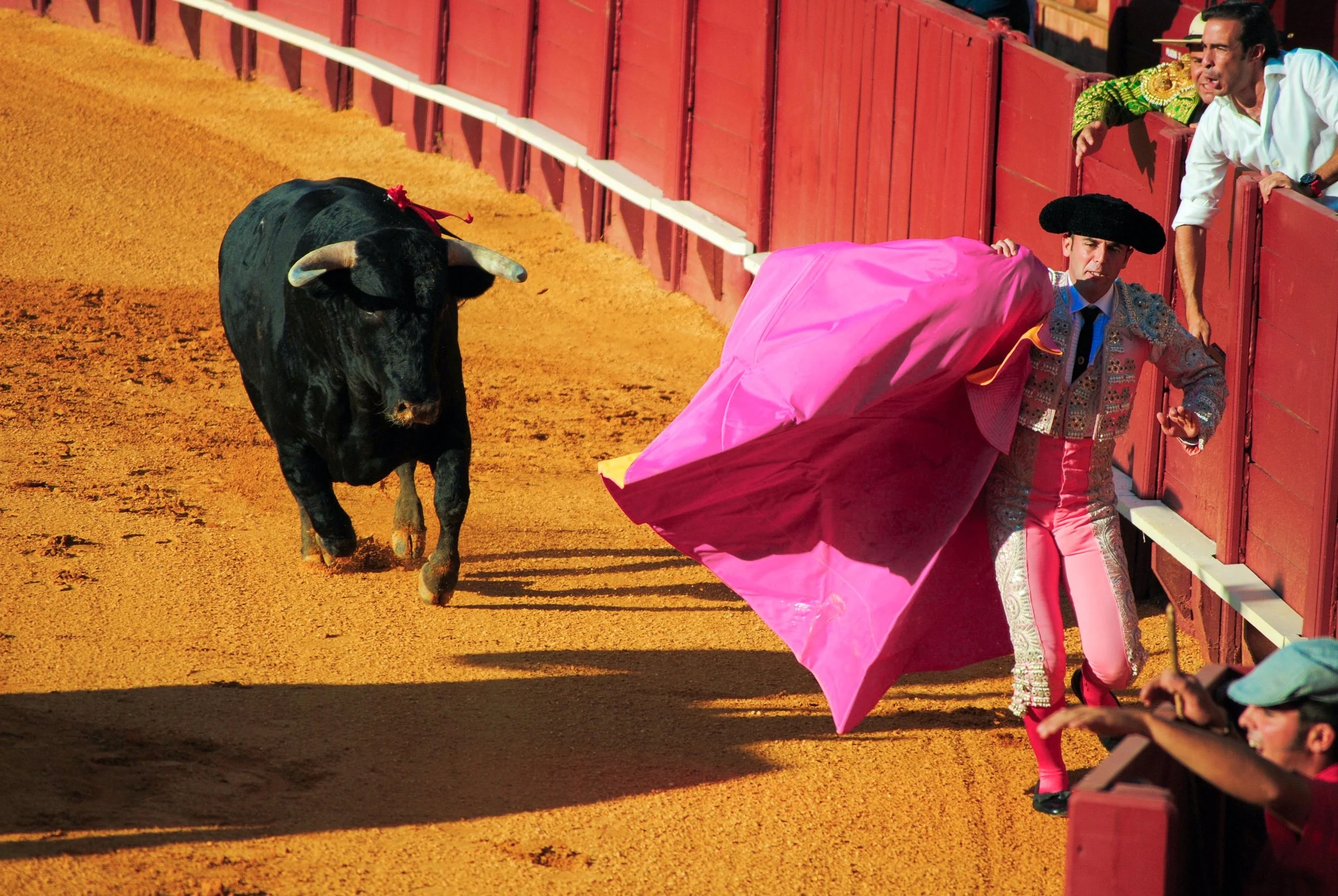
A matador narrowly evades a charging bull in Sevilla
MOROCCO
Official Language: Arabic | Area: 504,782 sq-km | Population: 36.03 million | Capital City: Rabat | Currency: Moroccan Dirham
Located a stone’s throw away from the Spanish coast, Moroccan culture is seamlessly blending the new with the old. The ancient medina walls offer a glimpse into past kingdoms while the streets of Casablanca are brimming with a new generation of chic youth.
SEE & DO:
Fine tune your bartering skills at the Djemaa el-Fna square in Marrakesh. Stick around after the sun goes down and feast at one of the open-air food carts.
Get lost in the ancient Medina of Fez and follow your nose to one of the ancient leather tanneries.
Pay a visit to a local hammam, a traditional Moroccan bath.
Trek through the Atlas Mountains and immerse yourself in the Berber culture.
EAT: Couscous (crushed and steamed balls of durum wheat and topped with heaps of vegetables or meat).
DRINK: Mint tea, a staple of the Moroccan culture.
WATCH: Marrakesh with Chrissy Teagen, Breakfast Lunch & Dinner S1E2 (Netflix).
ONE WORD: Labas, how are you?
KNOWN FOR: Sahara Desert, tagine, Chefchaouen (a village where very house is painted blue), abundance of spices, Atlas Mountains.
RANDOM FACT: The minaret of Casablanca’s Hassan II Mosque rises to 210m and is the largest in the world while the mosque itself holds 25,000 worshipers at prayer.

The Hassan II Mosque’s minaret towers over visitors

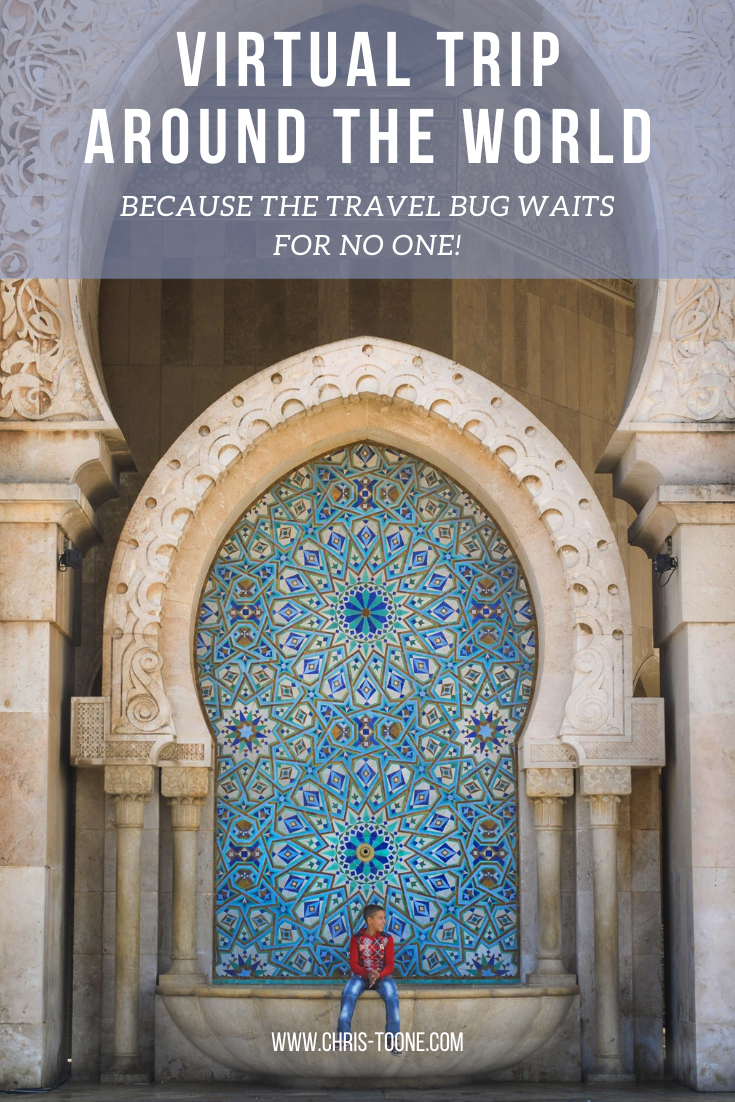
A boy sits at the Hassan II Mosque in Casablanca
GHANA
Official Language: English | Area: 446,550 sq-km | Population: 29.77 million | Capital City: Accra | Currency: Cedi
Commonly touted as "Africa for beginners," tourists love visiting Ghana because of its laid-back atmosphere, colorful culture, and ease of travel. To truly understand the people, pay a visit to one of the several slave castles that dot the coast and learn how the country became the first African nation to achieve independence in 1957.
SEE & DO:
Wander through the canopy at 40m above the forest floor in Kakum National Park.
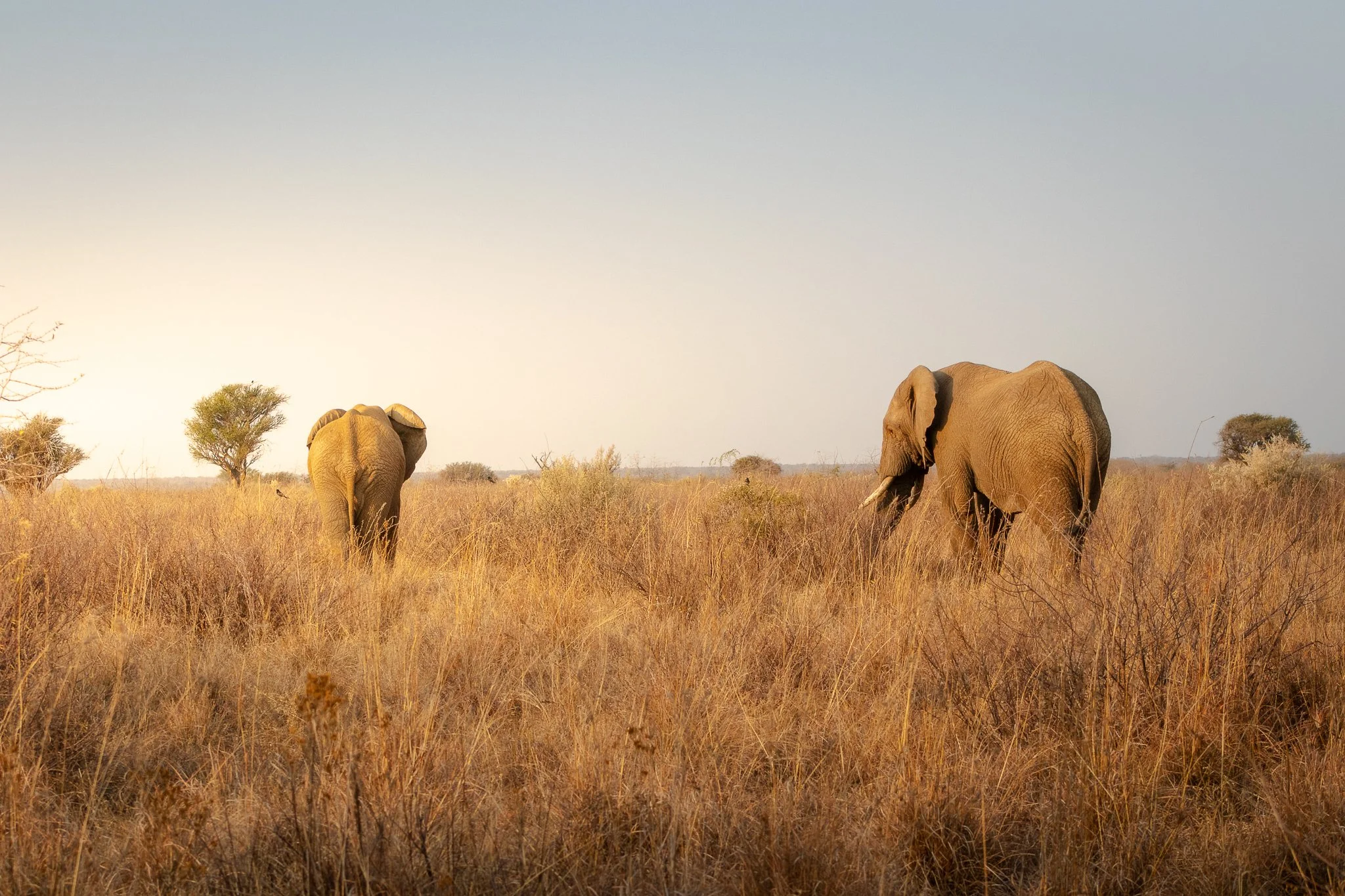
Walk with elephants at one of Africa’s cheapest safaris in Mole National Park.
Soak up the sand between your toes and sleep in a thatched hut at Maranatha Beach Camp.
Get turned around in Accra’s Makola Market, but somehow still find everything you need.
Allow yourself to be overcome with emotion at one of Ghana’s forts as you stare at the ominous “Door of No Return” where slaves once left their homeland behind.
Experience all that Kejetia Market, West Africa’s largest, has to offer in Kumasi.
EAT: Fufu and bofrot (Ghana’s version of a donut).
DRINK: Palm wine from a villager’s homemade stash.
ONE WORD: Hani-Wodzo, let’s dance!
KNOWN FOR: Coastal forts, high-life vibes, beautiful beaches, colorful culture, “Africa for beginners”, friendly people.
RANDOM FACT: 20% of all cocoa beans come from Ghana, making this West African nation the second largest producer in the world.

A visitor carefully navigates the swinging canopy walk at Kakum National Park

Maranatha Beach Camp, Ghana
SOUTH AFRICA
Official Languages: Afrikaans, Venda, Tsonga, English, Southern Soto, Swati, Zulu, Tswana, Ndebele, Xhosa, Northern Soto | Area: 1,219,9090 sq-km | Population: 57.78 million | Capital Cities: Pretoria (administrative), Bloemfontein (Judicial), Cape Town (Legislative) | Currency: Rand
It wasn’t until 1994 that a democratically-elected government took control of South Africa, making it a relatively young country in regards to independence. The effects of the previous regime’s ruthless apartheid policy can still be felt throughout the nation, but the people are determined to rebuild a better tomorrow.
SEE & DO:
Hike to the top of Table Mountain and Lion’s Head Peak for stunning views over Cape Town.
Take the ferry to Robben Island and learn how apartheid ravaged the country until 1994 when the first democratic government was formed.
Bushwalk through Kruger National Park and spot elephants and zebras at dawn.
Travel to the Cape of Good Hope, South Africa’s southern tip. Be sure to make time to visit the penguins at Boulder Beach as well.
Trace the path of the FIFA 2010 Soccer World Cup, the first and only held on African soil.
Need more trip ideas? Check out these activities!
EAT: Vetkoek, a multi-use pastry commonly stuffed with minced meat and eaten as a savory snack or topped with jam for dessert.
DRINK: Wines from the Cape Winelands, Springbok shot (paying homage to South Africa’s national rugby team, the shooter combines creme de menthe and Amarula).
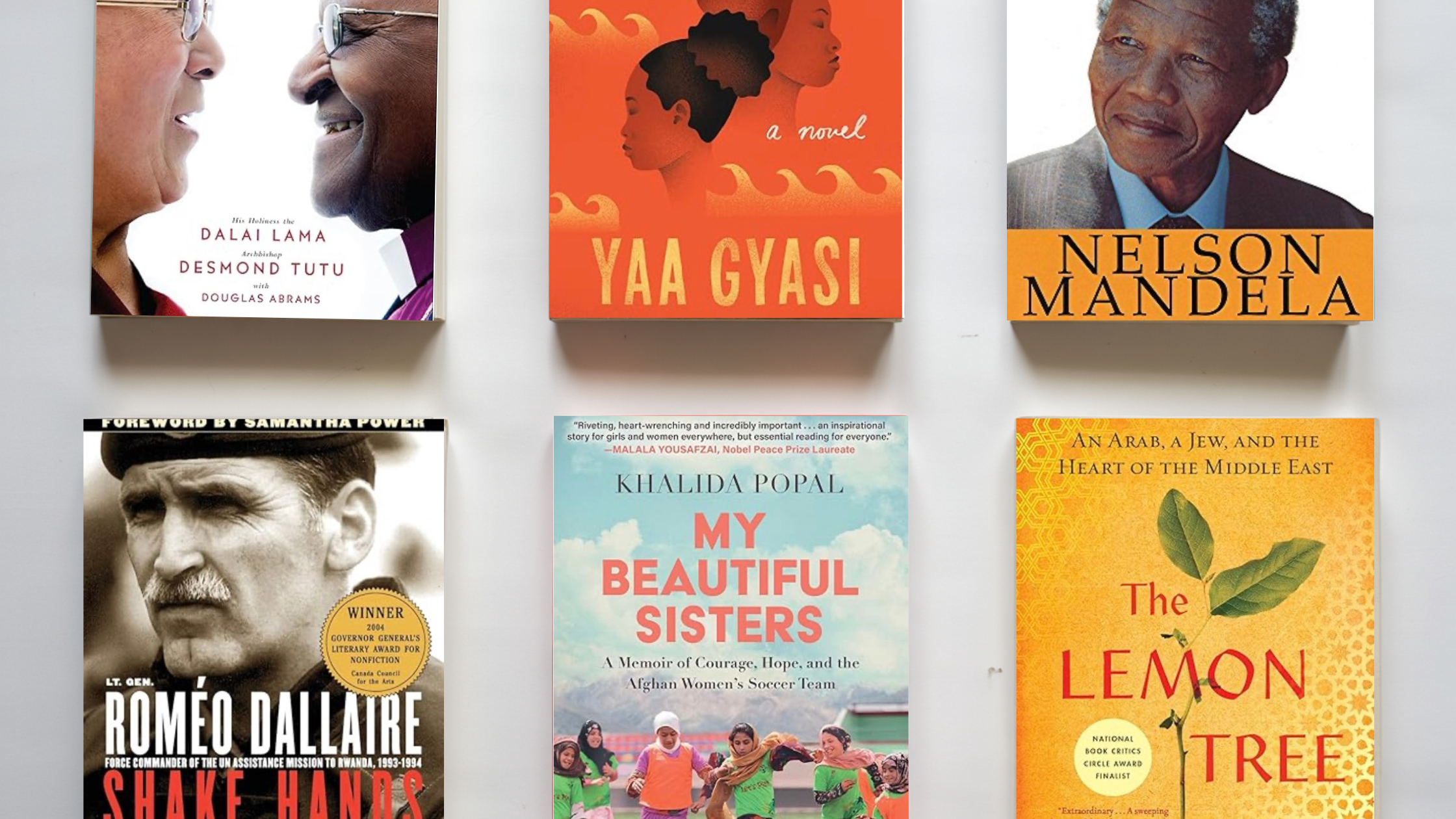
READ: Nelson Mandela’s inspiring autobiography, Long Walk to Freedom, and Archbishop Desmond Tutu’s emotional account of the Truth & Reconciliation Committee as the nation embarked on a long and painful healing process after apartheid, No Future Without Forgiveness.
WATCH: Cape Town, Somebody Feed Phil S2E5 (Netflix)
ONE WORD: Ubuntu (I am, because we are; a testament to the interconnectedness of humanity).
KNOWN FOR: Table Mountain, Springboks Rugby, Kruger National Park, Nelson Mandela, Archbishop Desmond Tutu, freedom fighters, unity.
RANDOM FACT: There are more than 2,000 shipwrecks off the coast of South Africa that date back 500 years.

Lion’s Head Peak at Sunset, Cape Town
MAURITIUS
Official Language: English, French, Creole | Area: 2,040 sq-km | Population: 1.265 million | Capital City: Port Louis | Currency: Rupee
Frequently overshadowed on a map by its neighbor, look for a small dot to the east of Madagascar and you’ll find Mauritius. A tiny island full of pristine beaches, creole cuisine, and stunning highlands, it’s a slice of paradise in the Indian Ocean.
Craving to learn more about Mauritius? Check out this post:
SEE & DO:
Visit the cascading Chamarel Falls and mesmerizing Seven Colors of the Earth.
Hike through Black River Gorge National Park.
Relax on the beaches of Grand Baie.
Wander through the lively Port Louis Market.
Walk around the Sir Seewoosagur Ramgoolom Temple.
EAT: Camarons (freshwater prawns in spicy sauce).
DRINK: Phoenix Beer from Mauritius’ largest brewery.
ONE WORD: Kreol Morisien (Welcome).
KNOWN FOR: Phoenix beer, beach resorts, land of the lost dodo bird, sugar cane plantations, religious tolerance, island vibes.
RANDOM FACT: Electricity from sugar cane accounts for 14% of the island’s needs.

Black River Gorge
INDIA
Official Languages: English, Hindi, Bengali, Telugu, Marathi, Tamil, Urdu, Gujarati, Malaalam, Kennada, Oriyu, Punjabi, Assamese, Kashmiri, Sindhi, Sanskrit | Area: 3,287,263 sq-km | Population: 1.353 billion | Capital City: New Delhi | Currency: Indian Rupee
India often feels like a world of its own with so much diversity between north, south, east, and west. Traveling here requires stepping out of your comfort zone with all of the sights, sounds, and smells constantly overwhelming the senses, but it’s worth the effort.
SEE & DO:
Float down the Ganges River at sunrise in Varanasi and observe the morning cleansing and cremations along the ghats on shore.
Stand speechless at the entrance to the Taj Mahal.
Ride an overnight train for a true Indian experience.
Navigate rush hour in the gridlocked cities of Mumbai and Kolkata.
Catch a glimpse of Mt. Everest in Darjeeling.
EAT: Chaat (a savory snack served at roadside stalls).
DRINK: Scalding hot chai tea, lassy (a refreshing sweet or salty yogurt shake).
READ: Around India in 80 Trains by Monisha Rajesh.
ONE WORD: Dayaf, baya, sidha (right, left, straight, because a trip to India almost certainly requires directing your rickshaw).
KNOWN FOR: Holy cows, Taj Mahal, Gandhi, Himalayas, towering temples, Bollywood, hectic driving, Holi Festival.
RANDOM FACT: The Taj Mahal’s dome was covered in bamboo scaffolding in 1942 as a way to protect and disguise it from German bomber planes during World War II.

Mid-day viewing of the Taj Mahal with the masses.
SINGAPORE
Official Languages: Chinese, Malay, Tamil, English | Area: 697 sq-km | Population: 5.64 million | Capital City: Singapore | Currency: Singapore Dollar
Careful not to break the rules here as it’s known for strict regulations. Even chewing gum finds itself on the list of banned substances, but don’t be deterred. Singapore might be small in size, but it’s a cultural melting pot of food and people.
SEE & DO:
Wander the Waterloo St. temples and markets.
Soak up the sights, smells and sounds of Little India, Singapore’s ode to the bustling subcontinent.
Swim high above the city at one of the most famous infinity pools in the world, located at the Marina Bay Sands Hotel.
Enjoy a cold drink at Clarke Quay, a popular riverside hangout with plenty of bars and restaurants.
Take in a bird’s eye view aboard the Singapore Flyer, the city’s iconic ferris wheel.
Check out these guides for a comprehensive list of things to do in Singapore!
EAT: Any and all hawker food. Singapore is a place where cultures converge, so it’s only fitting that you try all it has to offer.
DRINK: Tiger Beer, Singapore Sling.
WATCH: Singapore, Somebody Feed Phil S4E3 (Netflix).
ONE WORD: Kiasu. This represents a person’s fear of losing, something that is a staple of sorts within the population.
KNOWN FOR: “No Durian” signs, strict laws including hefty fines for spitting and littering, Tiger Beer.
RANDOM FACT: Singapore is the world’s largest exporter of exotic aquarium fish.

Downtown Singapore
VIETNAM
Official Language: Vietnamese | Area: 331,210 sq-km | Population: 95.54 million | Capital City: Hanoi | Currency: Dong
Organized chaos is the best way to describe the buzzing streets of Saigon as motorbikes whiz by. For a country ravaged by war, the Vietnamese people are a smiley bunch that are eager to show their homeland to everyone and anyone willing to visit. Fresh food, friendly faces, and never a dull moment; what more do you need?
SEE & DO:
Slurp a steaming bowl of pho from the comfort of a rickety plastic stool on the streets of Ho Chi Minh City.
Hire a local fisherman and float the back channels of the Mekong Delta.
Play a game of human frogger in the cities as you try to dodge motorbikes from all directions before giving up and riding one yourself.
Explore the picturesque terraced rice fields in Sapa.
Live on a boat amidst the towering rock formations of Ha Long Bay.
EAT: Pho, Goi Cuon (spring roll).
DRINK: Cafe sua da (Vietnamese iced coffee, also known as crack coffee).
WATCH: Vietnam, Anthony Bourdain: Parts Unknown S4E4.
ONE WORD: Thu’o’ng (th-uong) which describes something that is more than love.
KNOWN FOR: Conical hats, scooter mayhem, Mekong Delta, pho, “same same but different”.
RANDOM FACT: According to ancient Vietnamese folklore, Vietnamese people are descendants of dragons.

Boats docked along the Mekong Delta

A fisherman navigates the offshoot rivers of the Mekong Delta
HONG KONG
Official Languages: Chinese Cantonese, English | Area: 1,110 sq-km | Population: 7.45 million | Capital City: Central | Currency: Hong Kong dollar
Most recently, Hong Kong has created headlines around the world as tensions with China have reached a boiling point. Needless to say, the tiny island is living through a turning point in its history with new, more restrictive regulations. There’s only one question: what will the outcome be?
SEE & DO:
Explore Sham Shui Po, one of the oldest districts in Hong Kong that’s known for it’s textile industry.
Hop aboard the iconic Star Ferry for some of the best views of the city’s skyline from Victoria Harbour.
Reach the top of “The Peak”, the city’s best birds eye view, and marvel at the sheer magnitude of the metropolis below.
Be hypnotized by the extensive evening light show of downtown’s buildings.
EAT: Street food. Widely available, affordable, and a great snack for exploring. Some popular ones include curry fish balls, pineapple buns, and egg tarts.
DRINK: Red bean ice (red beans, sugar syrup, and milk).
WATCH: Hong Kong, Samantha Brown’s Places to Love S2E1 (PBS).
ONE WORD: Gay-dor-cheen-ah (how much is this?) because let’s face it, Hong Kong isn’t the cheapest place to visit in the world.
KNOWN FOR: Skyline views, Victoria Harbour, dim sum, luxury shopping, and political strife with China.
RANDOM FACT: Hong Kong means “fragrance harbor” in Cantonese.

Hong Kong as seen from the top of the The Peak
CHINA
Official Language: Mandarin | Area: 9, 596,961 sq-km | Population: 1.39 billion | Capital City: Beijing | Currency: Chinese Yuan
China is an intellectually intriguing nation to visit. On the surface, the vast country is filled with stunning scenery found nowhere else in the world, but dig a little deeper and the government’s harsh policies rear their ugly head. Where do you fall on this spectrum? One must visit to find out!
SEE & DO:
Hike the Great Wall of China.
Be humbled at the shear vastness of the country by taking a train from east to west.
Head to Yangshuo and float the Li River amongst the towering peaks that seemingly shoot straight up towards the sky.
Observe, learn, and practice T’ai chi each morning in one of the peaceful parks.
Walk the famous Shanghai Bund.
Uncover the 6,000 sculptures of Xi’an’s terracotta warriors.
Need help planning your trip? Here’s a list of curated guides to help!
EAT: Sichuan cuisine and it’s iconic fiery pepper seasoning.
DRINK: Tea at a traditional teahouse where the leaves are rolled, brewed, and roasted for an unmatched and unimaginable aroma.
READ: Peaks on the Horizon, a harrowing tale about one man’s escape from Chinese Authorities in Tibet.
ONE WORD: Ren, meaning to endure.
KNOWN FOR: Calligraphy, t’ai chi, Olympic Games, holistic medicine, the “ghosts” of Tibet, an up and coming wine industry, ancient culture.
RANDOM FACT: China is recognized by the Federation of International Football Association as having the oldest documented version of soccer during the Han Dynasty, over 2,000 years ago. The game was called “Tsu’ Chu” which translates as “kicking ball”.

The city of Guilin, the gateway to Yangshuo

Bamboo rafts float down the Li River in Yangshuo
JAPAN
Official Language: Japanese | Area: 377,915 sq-km | Population: 126.5 million | Capital City: Tokyo | Currency: Yen
No trip to Japan would be complete without venturing outside of the futuristic cities and into the past. The country prides itself on preserving its ancient culture, making it easy to stumble upon relics from throughout history. While you’re at it, be sure to take a deep dive into the food scene that awaits.
SEE & DO:
Hop between 7-11 and Lawsons for the quintessential Japanese convenience store meal, a staple of traveling through the country.
Get lost in busy streets of Tokyo and visit the world’s largest crosswalk at Shibuya.
Explore the zen gardens in Kyoto while trying to spot Geishas.
Confront the dark history of the world at Hiroshima and Nagasaki.
Play with the deer in Nara, Japan’s ancient capital.
EAT: Sashimi, ramen, and gyoza.
DRINK: Shochu, the national spirit of Japan.
READ: Rice Noodle Fish, an unmatched culinary adventure through Japan’s food culture.
WATCH: Japan: Hokaido, Anthony Bourdain: No Reservations S7E8.
ONE WORD: Danryoku-sei, meaning resilient.
KNOWN FOR: Mt. Fuji, cherry blossoms, sushi, sumo, anime, kimonos, and Tokyo’s massive public transport system.
RANDOM FACT: Japan’s rail system is one of the most efficient and on-time around the world, so rush hour requires professionally employed “pushers” to make their rounds and shove passengers into the packed car for trains to run on schedule.

Todaiji Temple in Nara, Japan
Voila! You’ve completed a trip around the world. Although the future of travel still seems uncertain, it’s never too early to start planning your next great adventure. At the very least, it takes the edge off the travel bug a bit, right?
Need more information about a destination? Want my personal recommendations? Leave a comment below and let’s start putting your next adventure together!
Stay safe, wear a mask, & happy travels!
Enjoy this post? Pin and share it with friends!




Dancheong: The meaning behind South Korea's beautifully painted temples
Ever wonder why South Korea's temples are all the same colors, regardless of design and location? The answer lies within a single word: Dancheong. Here's the story of what it all means.
Ah, South Korea.
A land that seeks to balance urbanization with rich cultural traditions. A place where one can simultaneously feel overstimulated and completely at peace.
At times it felt as though I was embedded into one giant oxymoron, or maybe it’s just the one place in the world that had it “all figured out.”
Both are extreme exaggerations, but the country completely captivated me during my time there (the seemingly endless supply of dumplings and kimchee sure didn’t hurt, either).
In general, I tend to notice the subtle things when I’m in a new place and South Korea was no different. It’s these microscopic findings that keep me up at night, trying to critically think my way toward a novice interpretation of my surroundings.
As I wandered around the palaces of Seoul, I couldn’t quite pinpoint why all of the buildings were decorated with the same vibrant hues of red, blue, and green, but it gnawed away at my mind to the point of feeling compelled to write this post and share it all with you.
Yes, ok, it’s only natural to assume that there is some religious meaning tied to Buddhism, and, generically, that’s not wrong, but I’m talking more specifics.
Why are the brush strokes the way they are? Why are the colors so limited? Why so bright?
The answer lies in one word: Dancheong
THE HISTORY
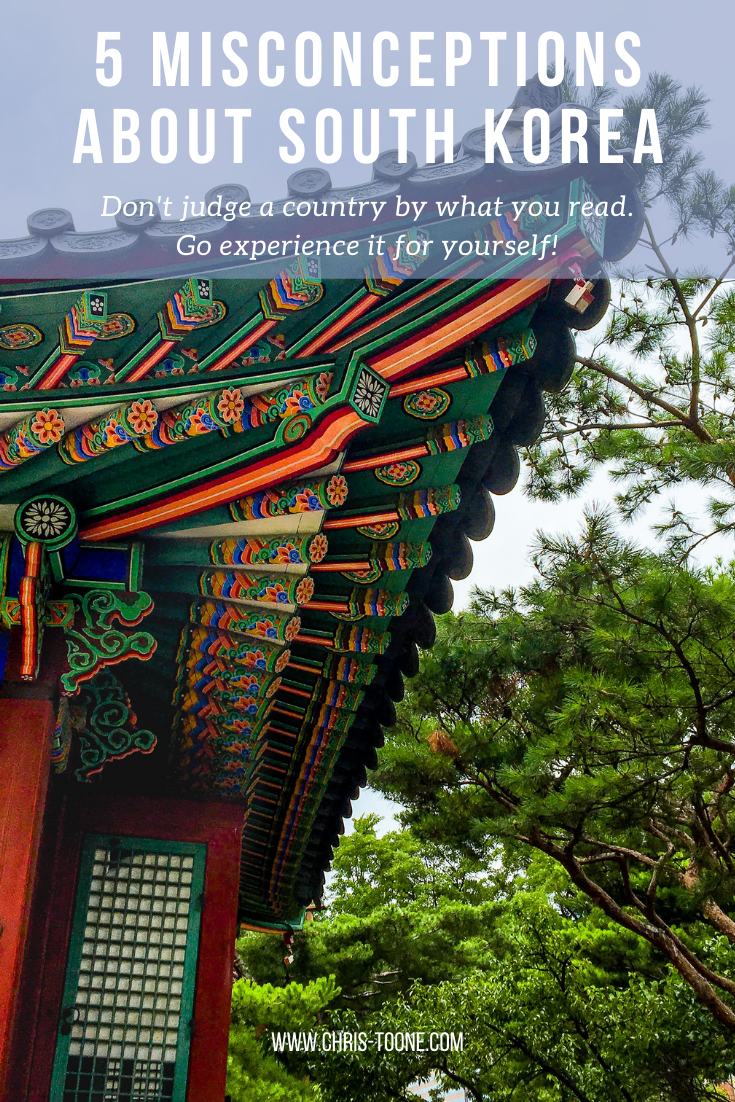
Dancheong is the symbolism behind all of South Korea’s beautifully painted temples, referring to the uniform five-colored designs. The word can be translated directly as “red and green” and dates back to prehistoric times when the concept was found to be adorning the walls of tombs from the Three Kingdoms of Korea era (57 BC - 668 AD).
As time went on, dancheong spread from places of eternal rest to buildings of prominence. Not only did the vibrant design convey the importance and status of the residents, but it also served as a meaningful way to preserve and protect the wooden structure from the weather.
To this day, dancheong is limited to temples and palaces and in some cases, musical instruments.
Looking for more reading about South Korea?
THE COLORS AND SYMBOLS
All dancheong designs use the same five colors, each relating to the 5 elements theory in their own way:
blue: east, dragon, spring, and wood
red: south, birds, summer, and fire
white: west, tiger, fall, gold
black: north, hyeonmu (an imaginary animal that is part turtle and part snake), winter, and water
yellow: center, periods of time between seasons, and Earth
Together, it is believed that these colors epitomize the Korean desire for stability and peace in the present life, while working towards a rewarding afterlife.
Creating the masterpiece is just as much a work of art as the finished product itself.
Artisans must operate in unison to devise these complex and intricate designs, all while utilizing various symbols and patterns.
As one might imagine, highly specialized painters are required and each artist working on the project is responsible for one single color throughout the entire process.
Common symbols found throughout a dancheong design include:
3 circles: typically outside of large buildings and located up towards the roof, these represent heaven, earth, and the moon
Fish symbol: when located on the main Buddha table, this represents the effort and determination necessary for attaining eternal enlightenment
Swastika: Ancient buddhist symbol of peace, harmony, and good luck
Lotuses: Represents ignorance when rising from mud and enlightenment when ascending towards a clear sky

Location can also determine the color used. For example, exterior walls and pillars of buildings that receive sunlight are traditionally painted red
THE TYPES
The art of dancheong can be dissected into four main types, often identified based on location or patterns used.
Morucho: This is a pattern used on both ends of supporting beams, incorporating simple symbols such as a water lily, pomegranate, bubble, feather, or a green flower
Byeoljihwa: Traditional storytelling that is present between two morucho and consists of holy animals (such as dragons, lions, horses, or cranes) along with sagunja (specual plants such as plums, orchids, or bamboo) and scenes of the buddha sutra
Bidan munui: This pattern is full of diverse colors used to create geometric shapes
Dangdong munui: Used to describe when a single flower, animal, gemoetric shape, or pattern appears in one section
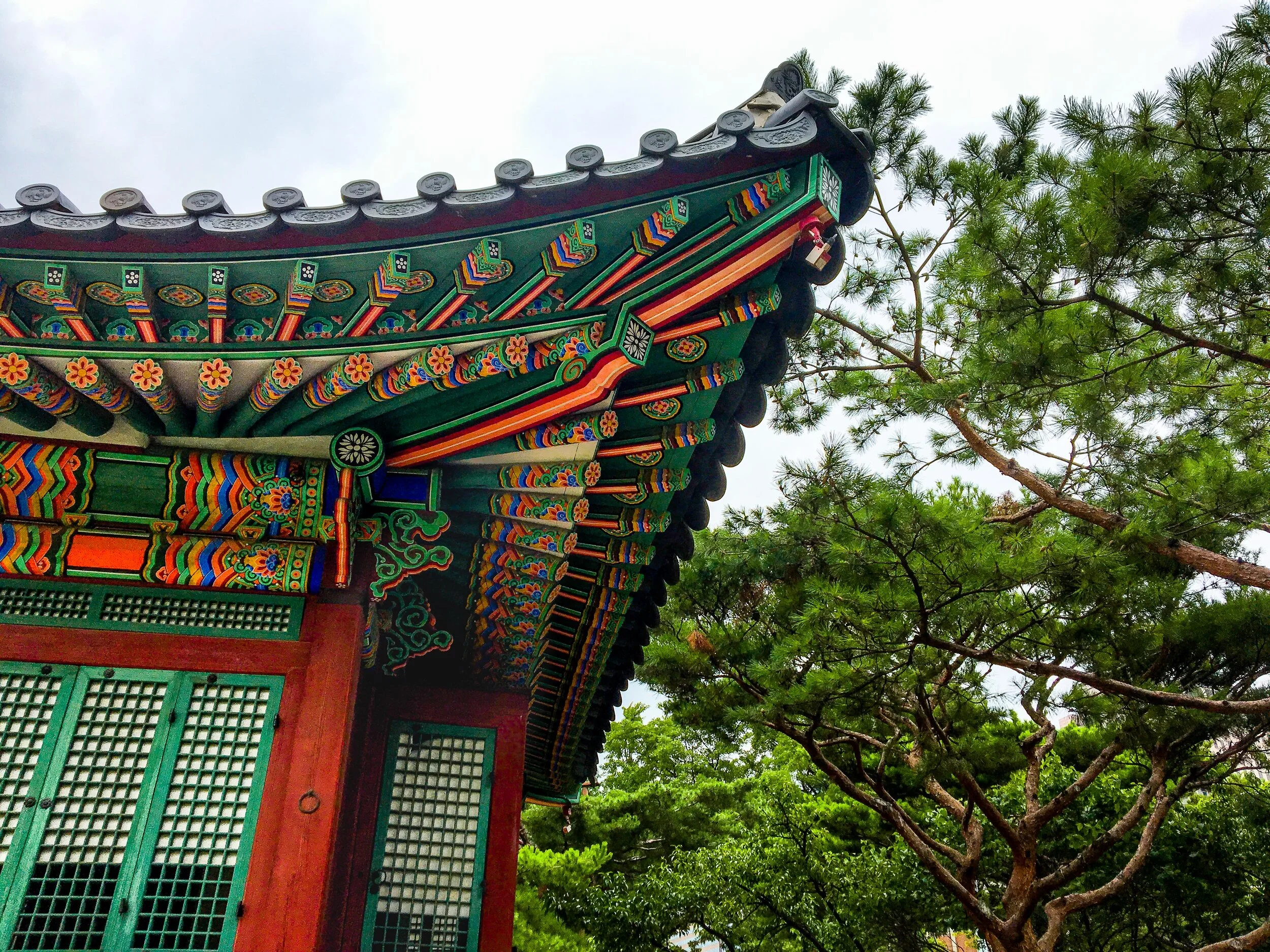
An example of morucho dancheong - a single flower is painted on the end of each beam
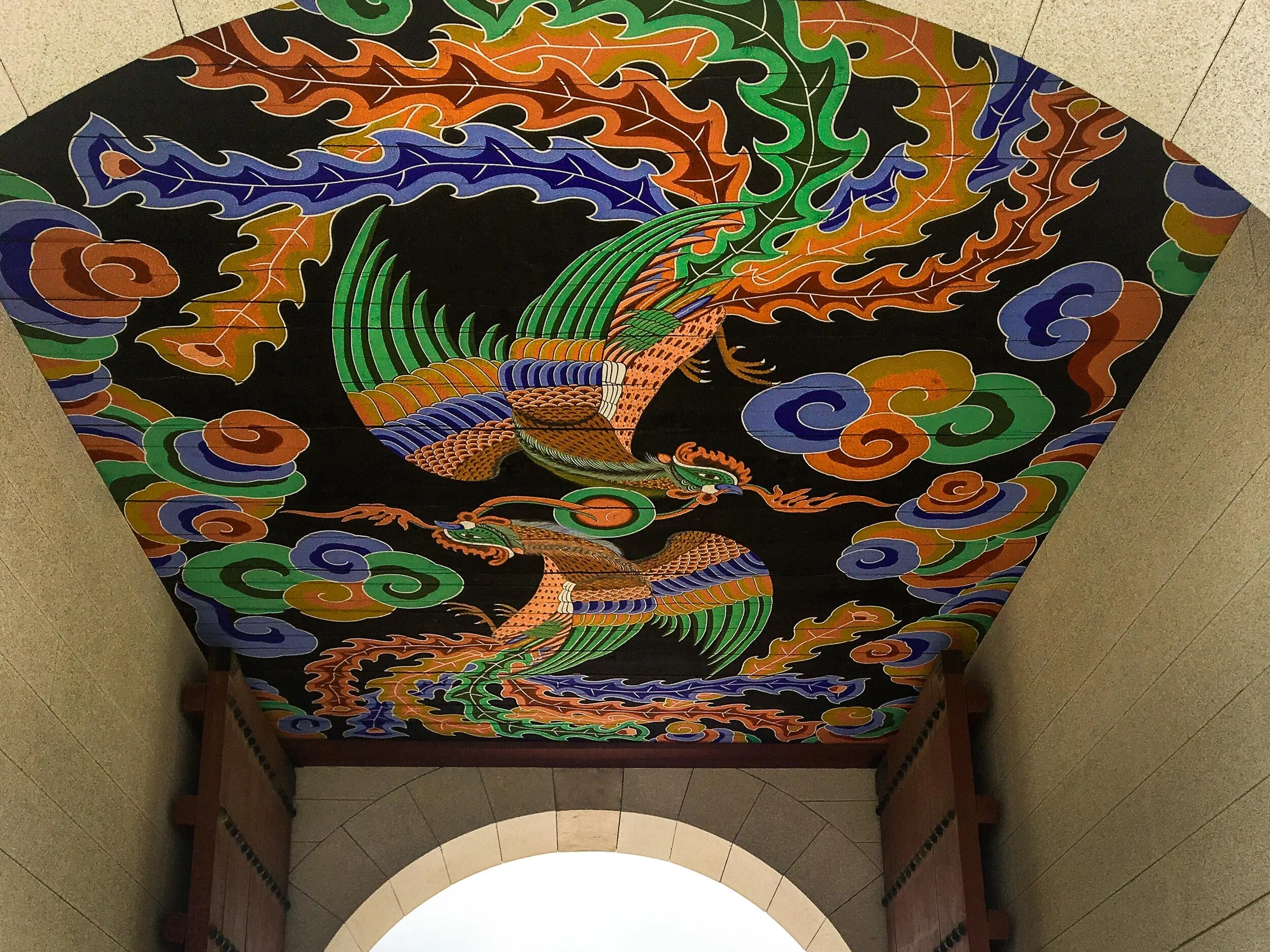
An example of byeoljihwa dancheong
So, there you have it. A brief story behind South Korea’s majestic and eye-catching temples, yet a much deeper understanding of ancient Korean values and beliefs. Next time you find yourself in new surroundings, or even in a place that you visit often but don’t know much about, be sure to take a step back and simply wonder. You never know what new meaning you might discover!
Thanks for stopping by and as always, stay safe & happy travels!
Sharing is caring… pin this post!


5 Common Misconceptions About South Korea: Here's what I learned during my first visit
Take a moment to think about South Korea. What comes to mind? Odds are it includes something along the lines of North Korea, kimchee, Buddhism, and not much more. That’s ok! Here are 5 common misconceptions about this stunningly beautiful and wildly underrated country, because their neighbors to the north shouldn’t be a reason to stay away.
Take a moment to think about South Korea. What comes to mind? Something along the lines of North Korea, kimchee, and Buddhism. I knew next-to-nothing about the country before I spontaneously booked plane tickets two weeks in advance — I'm not very planning-oriented when it comes to travel (learn from my mistakes and do a bit of preparation ahead time before visiting South Korea)!
Once word had spread about my upcoming adventure, it was only natural that my inbox was filled to the brim with a slew of questions:
Is it safe? What if North Korea attacks?
What if you don’t like the food?
How will you communicate? What happens if you need help?
To be honest, I couldn’t answer any of those questions at the time. I would simply stumble my way through a response to not only calm the nerves of those asking but my own as well.
It wasn’t until I arrived in South Korea and experienced all that it has to offer that I realized there was nothing to fear. So, here are 5 common misconceptions about this strikingly beautiful, amazingly peaceful, and wildly underrated country. Enjoy!
MISCONCEPTION #1: IT’S NOT SAFE
It’s only natural that when one thinks of South Korea, North Korea comes to mind. Technically speaking, the two countries are still at war (an armistice agreement was signed in 1953 that effectively ended all combat). There must be a plethora of safety concerns that come from this, right? Wrong.
Unless traveling to the demilitarized zone, there is seemingly no tension, emotional or physical, among South Koreans. Instead, the 10 million people living 50km away from the border in Seoul go about their daily life uninterrupted. It was easy to forget where I was in the world until I checked a map.
At the end of the day, South Korea is a very safe country to visit; don’t let its location in the world keep you away!
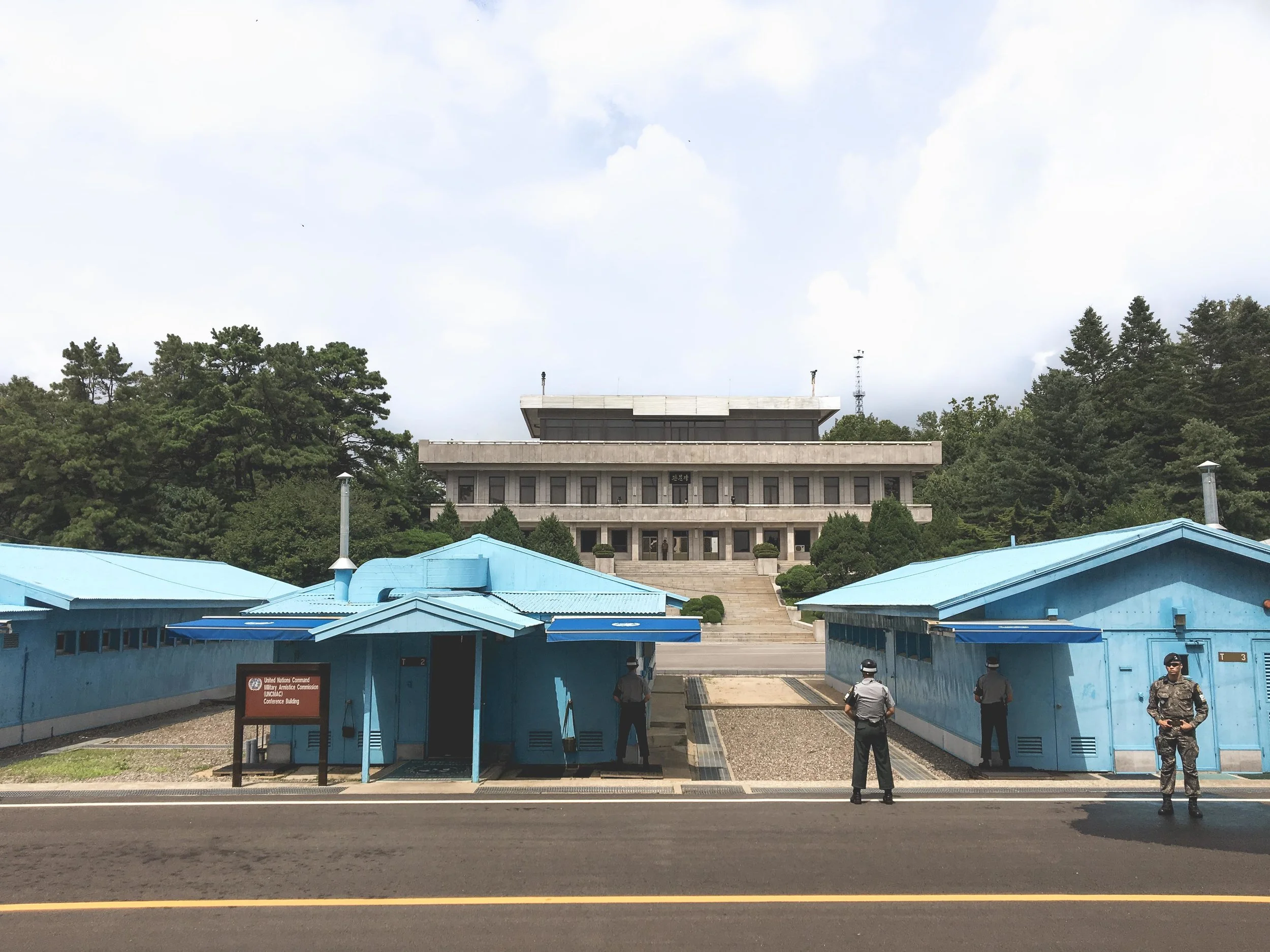
Demilitarized Zone at Joint Security Area - South Korea
MISCONCEPTION #2: IF YOU DON’T ENJOY BUSY CITIES THEN SOUTH KOREA ISN’T FOR YOU
Did you know that South Korea has the fastest internet in the world? Or that nearly 51.5 million people co-exist within a country similar in size to Tennessee?
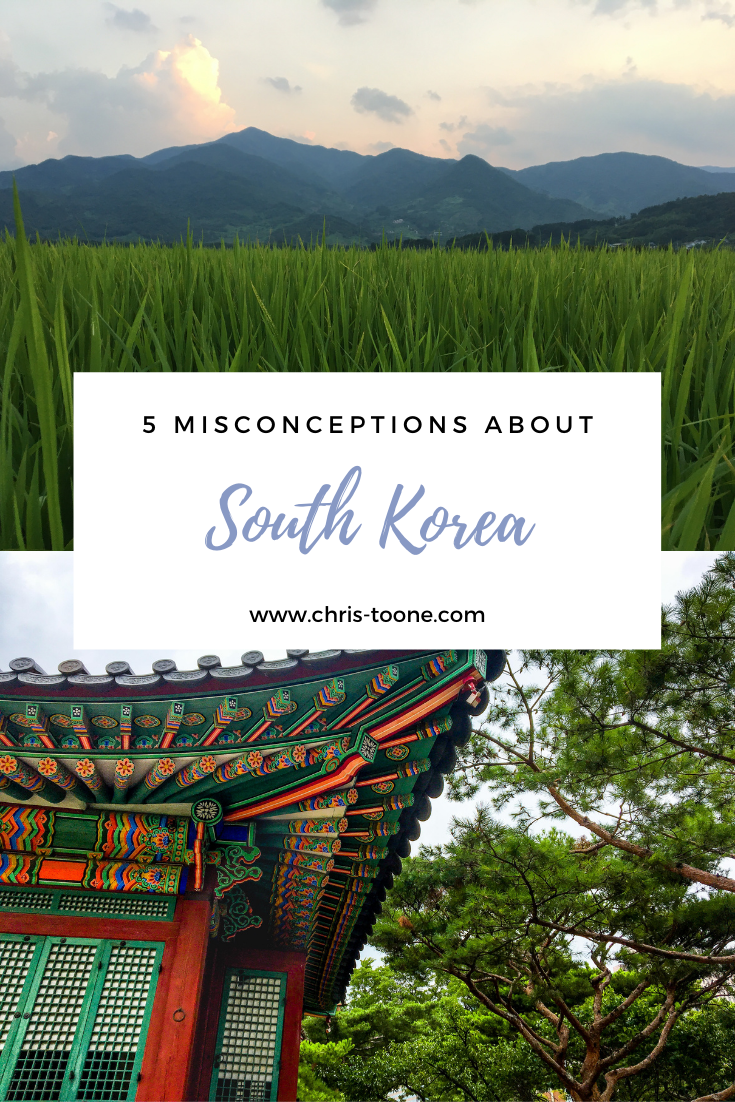
There are numerous facts that may lead one to believe that South Korea is a type of futuristic, technologically-advanced, population-dense country, especially when cities such as Seoul and Busan are often at the forefront of itineraries. What many don’t realize until they arrive is that over half of South Korea is covered in forests and mountains.
The best part? You don’t have to travel far to reach them!
Bukhansan National Park is located a mere 13km from Seoul, making it easy to trade in the city streets for a mountainside temple. If flora and fauna peak your interest over rocky cliffs, then be sure to wander around Dadohaehaesang, South Korea’s largest national park. Here you’ll spot over 1,500 species of plants and 140 different kinds of birds.
Mountains don’t do it for you? That’s fine. South Korea is also home to 2,313 km of coastline, including Jeju, the country’s own island paradise.
With so much to offer, there’s an adventure for everyone!
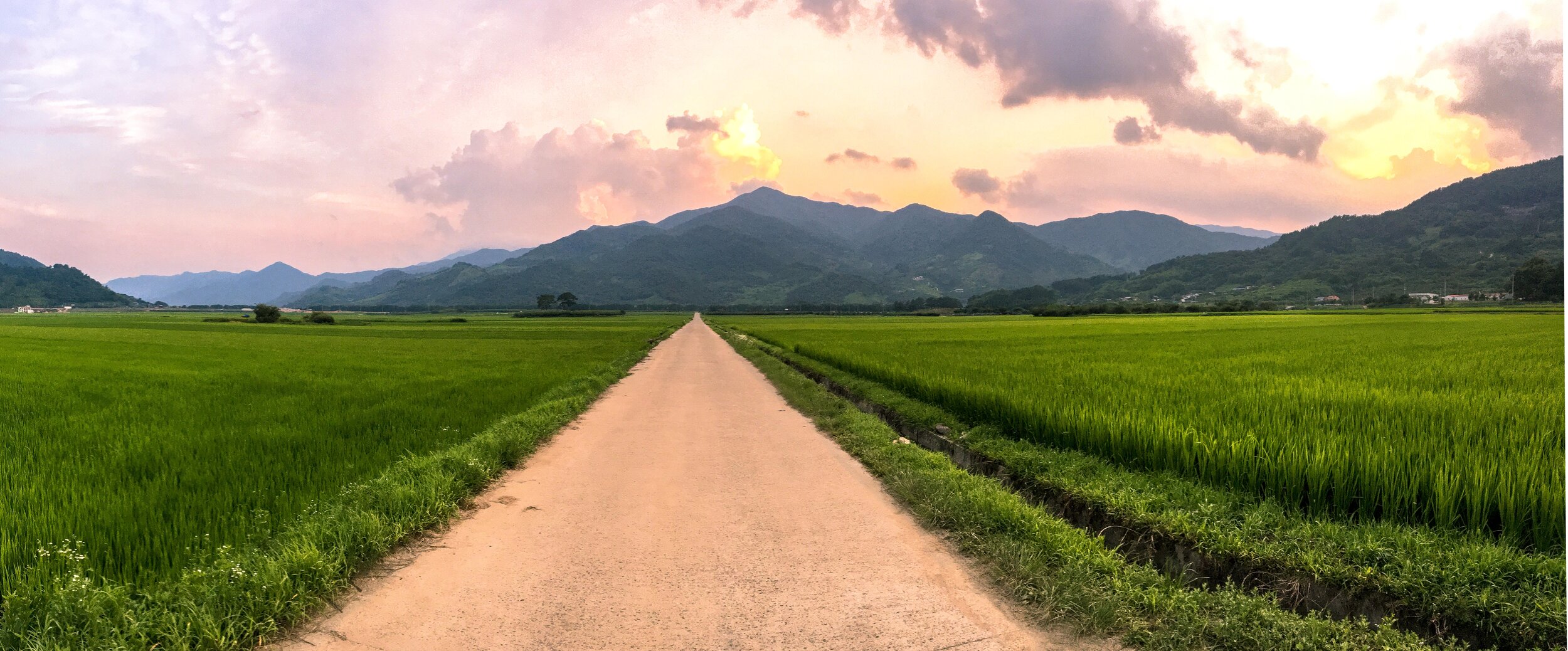
Hadong, South Korea
MISCONCEPTION #3: ALL SOUTH KOREANS SPEAK ENGLISH
Although English lessons are part of the modern-day South Korean education system, it’s important to realize that the language isn't always widely spoken.
As a result, English comprehension is generally, not always, limited to people under the age of 40. Older generations may know a few keywords and phrases but often aren’t comfortable conversing with someone fluent. There’s no harm in that, but what do you do when you’re lost and in need of help? Find a younger adult.
Seeking a more meaningful interaction and fewer charades?
Take a stab at learning Korean! Rather than relying on a plethora of confusing symbols, the language is based on a 24 character alphabet known as Hangul and is widely considered to be easier to learn than other languages such as Japanese and mandarin. The language wasn’t organically grown over time. Instead, the Hangul alphabet was specifically invented to be easy to use, in large part due to its phonetically-friendly nature.
Think of it as your passport into Korean society without much effort.
For more reading on South Korea, check out these posts:
MISCONCEPTION #4: BUDHISM REIGNS SUPREME
Buddhism may be one of the oldest religions in South Korea (established in 372), but the country has developed into a holy melting pot as centuries have passed. Yes, Buddhist beliefs remain a pillar of South Korea’s cultural heritage, as does Confucianism, but it’s only the second most practiced religion. A 2015 census showed that 19.7% of South Koreans identified as Protestants (thanks to North American missionaries dating back to the 19th century), which was more than both Buddhism (15.5%) and Catholicism (7.9%). Islam also continues to grow since the inception of the Islamic Society of Korea in 1955.
It’s hard to ignore the tens of thousands of temples constructed throughout the country but peel away the surface and you’ll find yourself staring deeper into a religious spectrum that many never realize exists, let alone experience.

Daewonsa Temple - South Korea
MISCONCEPTION #5: IT’S IMPOSSIBLE TO FIND NON-TRADITIONAL FOOD
South Koreans love their kimchee. Whether it’s served as a traditional side dish (known as banchan), stuffed inside of a dumpling, or simply a meal of its own, this spicy fermented cabbage is widely available for consumption at every turn. The same can be said of other traditional Korean dishes such as bibimbap (mixed vegetables and rice), tteokbokki (spicy Korean rice cakes), and makgeoli (a milky, off-white fermented rice drink).
Although the traditional culture and food are well preserved and respected throughout the country, the younger generation has grown up with more options that seemingly expand each day. South Korea ranks fourth in the world for the most Starbucks stores per capita (with 1,008 stores total, that’s one outlet for every 50,000 people) and it’s not uncommon to stumble upon the golden arches of McDonald’s as you meander through city streets. Despite what some may lead you to believe, it’s relatively easy to satisfy even the most western of taste buds.
It doesn’t have to be all big-business, though. How do fried chicken and beer sound?
Together, the two are known as “chimaek” and the obsession runs deep. So deep in fact that Daegu hosts an annual festival dedicated solely to this delectable combo — all the more reason to visit in July! You can read more about how this craze came to be by clicking here.

Gwangjang Market - Seoul, South Korea
So, what do you think? I hope that, in the very least, a trip to South Korea sounds more enticing than it might have prior to reading this post. Give it a go. After all, how do you know if you enjoy something if you don’t try it?
Thanks for reading and as always, stay safe & happy travels!
Pin this post and share with others!


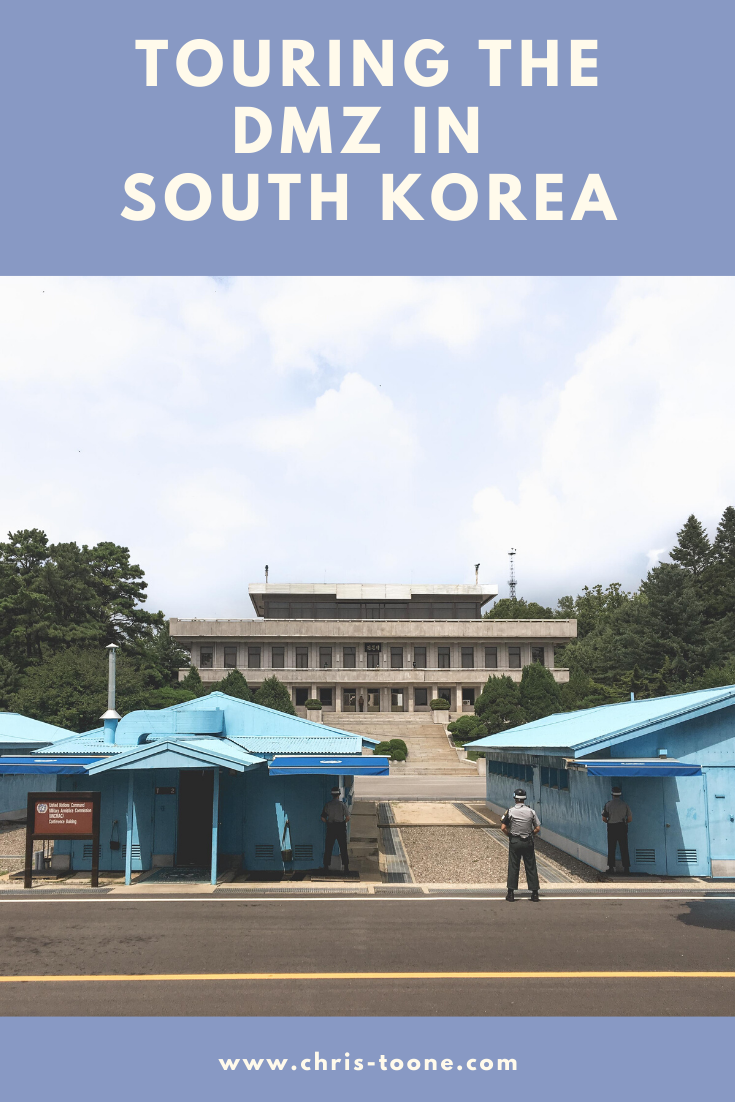
Touring The DMZ in South Korea: What it's like to stand at the most heavily guarded border in the world
A mere thirty miles outside of Seoul sits one of the most heavily guarded borders in the world. Spanning the entire 160-miles across the peninsula, the demilitarized zone creates a 2.5 mile wide proverbial “no-man’s land” that does more than simply divide the two countries…
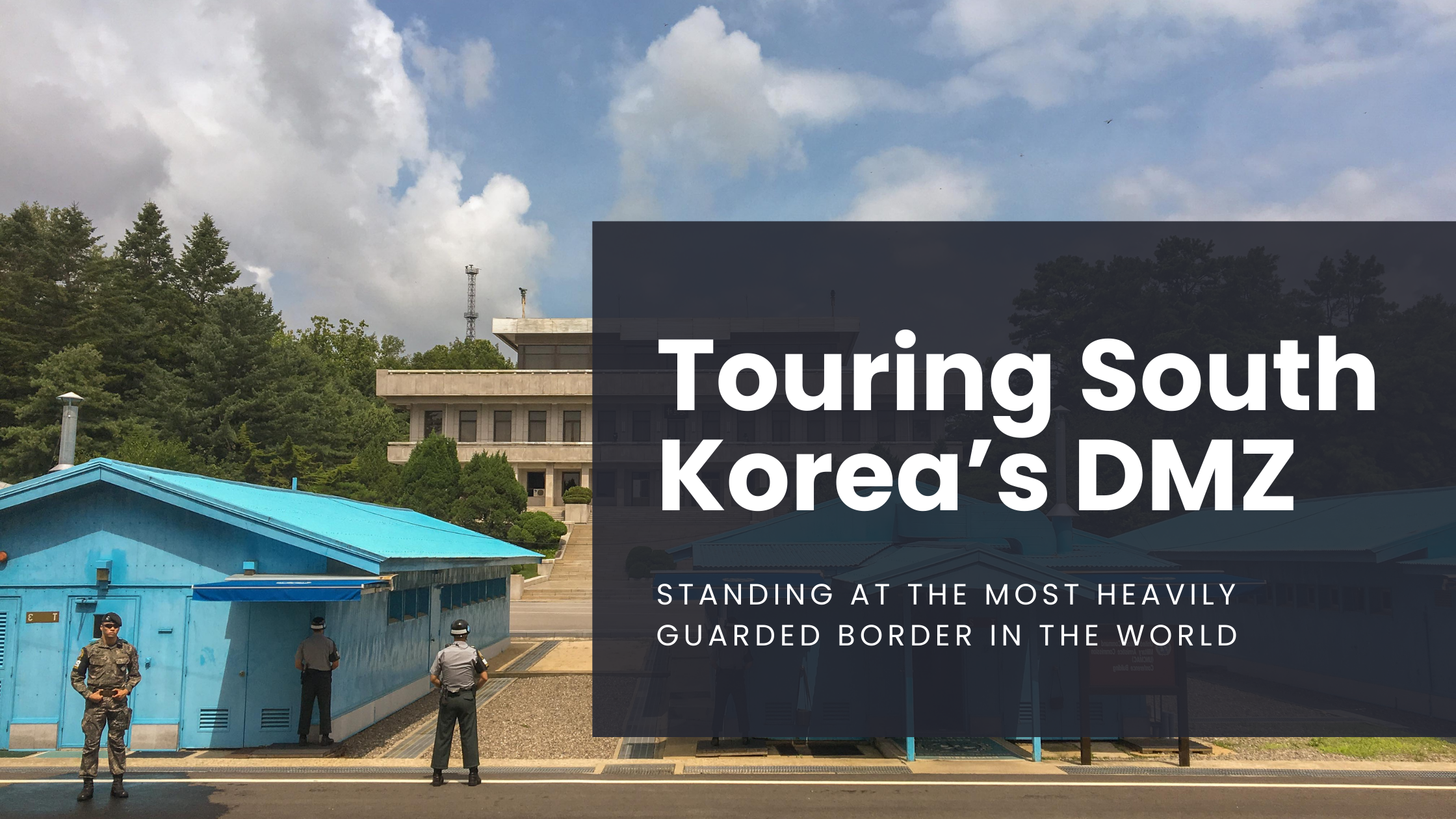
A mere thirty miles outside of Seoul sits one of the most heavily guarded borders in the world. Spanning the entire 160-miles across the Korean peninsula, the demilitarized zone creates a 2.5-mile wide proverbial no man's land.
The following piece documents what it felt like to stand on the border of North and South Korea, also known as the scariest place on Earth,coined by Bill Clinton after his visit in 1993.
Heather and I would normally never hop on a tour. Sitting on a bus and listening to a voice through a speaker is not in our travel DNA at this point in our lives. We’d much rather wander the streets of a new place, immersing ourselves in its surroundings.
In fact, that’s how most of our memorable adventures have started. It’s a rush of raw emotions when we turn a corner and discover something beautiful when we least expect it.
We had booked flights to South Korea with no set plans, knowing little about the country itself other than it was the cheapest ticket to Asia then.
Amidst the hours of reading, there was one tour that kept surfacing: visiting the border with North Korea. At first it was a joke. Both of us had come across it, brought it up to the other with a hint of a chuckle, and brushed it aside. It was a “hah, can you imagine if we went there?” moment more than anything else, but each successive time we laughed, the more real it became.
By the second day of researching, we had convinced ourselves to visit the Demilitarized Zone (DMZ), hoping for an opportunity to step over the line of demarcation and into the territory of their neighbors to the north. We booked the tour, gave each other a “what the hell are we doing” smile, and packed our bags.
Before we knew it, we awoke at dawn in Seoul, anxious to see where the day would take us.
With any new adventure comes adrenaline. There’s excitement for what lies ahead, accompanied by a nagging fear of the unknown. That’s normal. Yet as we stood on the street corner in the crisp morning air, something seemed off. I could feel a slight wrench in my gut, not out of concern but curiosity. We had traveled nearly 6,000 miles around the world and were about to visit an active war zone, one that continues to affect the daily lives of millions of people. It was going to be different than anything I had ever experienced before.
We arrived at the meeting point, handed over our passports for verification, and boarded the bus. The seats were far from full and we quickly realized we were the only Americans present.
After a short wait, a middle-aged South Korean woman climbed the steps and explained that she would be our guide today. It was time to go.
The first stop was the War Memorial of Korea. We didn’t have nearly enough time here to visit every exhibit, so we quickly shuffled our way to the “History of the Korean War” wing. It was here that we relived our days as college students, cramming as much knowledge as possible into our heads. As is the history of the world’s largest conflicts, that of the Korean War is quite complex and convoluted. This isn’t the platform to expand on it, but I would encourage you to look far beyond what the media presents to gain a better understanding.

War Memorial of Korea
Alas, it was time to continue the tour. Our driver turned right out of the parking lot, trading the sanctity of the museum for the chaotic streets of Seoul.
We continued driving along highway 77, flanked by the Han River to our left. I began tracking the bus’s movement on my phone’s GPS. Sure enough, we were heading due north, straight toward North Korea.
As I glanced out the window the skyscrapers of Seoul had been replaced by barbed wire fences. This was the first sign that we had reached the DMZ.
We veered to the right and began heading east, continuing to follow the fence line as we went. Guard towers whizzed by our windows every mile until we reached Imjingak Park.

DMZ border along Han River estuary
Constructed in 1972, this park was built on the southern side of the Bridge of Freedom as a sign of hope for unification. It has since expanded on that role, now serving as a popular tourist destination.
As we left the comforts of the air-conditioned bus and surveyed our new surroundings, we were both immediately taken aback by old photographs of Korean families sitting along the barbed wire fence, hanging messages of hope and peace as they prayed. Messages, to this day, still cover the barrier that separates them from their loved ones in the north.

Flags for peace at Imjingak Park
It all felt delicate. Physically it was there: The reinforced fencing, the beautifully placed banners, and more. It was palpable and sturdy.
The environment, however, was fragile. Yet within it grew a mob of tourists, elbowing and shoving for the perfect selfie of the South Korean flag that, although weathered, hung proudly on the fence and symbolized the strength of the people that placed it there.

Imjingak Park, South Korea
Maybe it was out of respect that we felt we had to quietly shuffle along the walking path, observing and learning as we went. After all, we showed up as tourists to a place that has experienced so much grief and heartbreak. To this day, South Koreans still ride the DMZ train from Seoul to sit in the park, stare north through the fence, and patiently wait for the day it comes crumbling down. They continue to tell themselves that somewhere out there exists an alternate universe, one where they can move freely throughout the peninsula and reunite with their families.
We took a break to eat lunch, trying to process what we had just witnessed. After slurping the final drops of broth we made our way up to the third floor where a viewing platform provided our first look at the expanse of no man’s land.
I’m not sure what I was expecting. War ruins? Abandoned homes? I found none of that. Pure is the only I can describe it.

Looking into “no-man’s land”
It has been reported that around 800,000 landmines are buried throughout this 160-mile long sliver of land. In a way, these weapons serve as protectors, allowing nature to grow without intervention from the human race.
Humbled by our visit, we returned to the bus. It was time to head farther north towards the Joint Security Area.
As we sat back down in our seats, the mood shifted. The chatter in the back of the bus was silenced by our guide explaining that we now must display our “United Nations Command” visitors pass at all times.
From that point on, we would be inside an active war zone. The bus began to slowly swerve as we continued on. Left, right, then back to the left, avoiding barriers as we crossed a bridge that spanned the Imjin River below.
A slight feeling of unease came over me as we passed through the military checkpoint, but it was time to visit the Joint Security Area (JSA), also known as the village of Panmunjom. It was here that we hoped to step foot into North Korea.
Our bus rolled to a stop at the entrance to Camp Bonifas, located just 400m south of the border. A mere quarter of a mile is all that separated us from the border. We filed into an auditorium, joining with other tour groups. As the seats filled, our new guides from the U.S. Army began dispersing visitor declarations. These documents stated that the U.S Army, UN Command, and the Republic of Korea could not guarantee the safety of visitors and may not be held accountable in the event of a “hostile enemy act.” Comforting, to say the least.
We signed on the dotted lines, nervously laughing at one another’s slight hesitation, then climbed the stairs onto a new bus and continued driving north.
Finally, we reached the Freedom House. Located on the South Korean side of the Joint Security Area, the structure was built to house the reunification of Korean families. It has yet to see such a day.
We received final instructions from our leader: At no time should we place our hands in our pockets. If we wish to use our phones for pictures, we must hold them the entire time. No waving, pointing or making any motion towards the North Korean side.
We were to remain in a single file line at all times. The Korean People’s Army would be closely monitoring our movements from their guard towers. Any misstep may be recorded and used as propaganda.
Interested in learning more about South Korea? Check out these posts:
With these warnings in mind, we were led into the foyer, up the stairs, and to the back doors. One by one we silently walked onto the platform outside, getting our first glances at North Korea.
Across from where we stood was the north’s version of the Freedom House, built taller than it’s South Korean counterpart as a sign of strength. Motionless in front of the door was a lone soldier from the Korean People’s Republic Army. To the far right was a guard tower, monitoring our every move. Directly in front of us stood three South Korean soldiers, attentive and facing the border.
Separating the two countries were three long, blue buildings that served as conference rooms. Here is where leaders from both sides come together for negotiations. Horizontally bisecting these buildings was a small block of cement; the official demarcation line between North and South Korea.
Joint Security Area, South Korea
Part of me couldn’t believe what I was looking at. It wasn’t awe-inspiring or beautiful beyond words by any means. Rather, to visualize where we were on a map of the world simply dumbfounded me. I was being watched by actual North Korean soldiers. I could see one for myself, close enough to yell at across the way.
The person next to me began to move, breaking my thought as we were ushered into the center building; an empty conference room awaited.
Three more South Korean soldiers were standing guard inside, one firmly planted in front of the door directly across from where we entered. That door led outside, straight into North Korea.
I took about ten steps forward, flanking the edge of the large conference table in the middle of the room. As I turned to glance out the window, I realized that I was looking back towards the cement demarcation line. Technically speaking, I had just crossed into North Korea.

Demarcation line between North and South Korea
After twenty minutes we were escorted back out of the southern entrance of the building, returning to the steps of the Freedom House for one final glance at North Korea. It was quite possibly the last one I’ll ever have.
What we didn’t know at the time was that those same buildings would be where Oh Chong Song dashed across the border, making his daring escape from North Korea a mere four months later.
To be honest, I’m still unsure what to make of the whole experience. Yes, we had just stepped foot in an active war zone, but the reality is that it’s as safe as possible. Up to 3,000 people tour the area each day.
Is it for everyone? Certainly not.
Was it one of the most humbling experiences of my life? Absolutely.
As we rode the bus back to Seoul that afternoon, I couldn’t help but admire the strength, resiliency, and patience of the South Korean people. Although the struggle for peace continues, many feel that it has never been closer.
I truly hope that’s the case.
Thank you for reading and as always, stay safe & happy travels.


After three years living in Ghana, these are ten of the most unforgettable travel experiences across Africa that changed how I see the world…